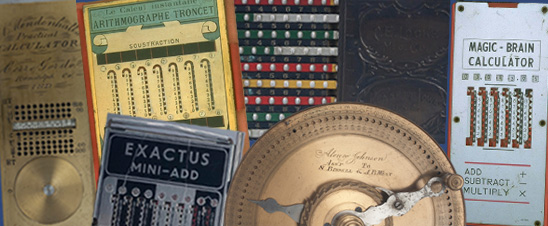
From the mid-19th century, Americans have used simple instruments to assist them in doing arithmetic. Some of these did not actually add and subtract, but made it easier for users to do so. These included not only the abacus, but also devices called adders. Adders were not invented in the U.S., but were among the first computing devices within the price range of ordinary Americans.
From the 1890s, as adding and calculating machines became common, a growing number of makers and dealers also offered these portable, less expensive instruments. By the 1920s, both businesses and individuals bought them. Some adders represented numbers by sliding rods, others used circular metal rings, and others used jagged metal bands that moved linearly. In the years following World War II, devices from abroad, particularly from Germany and Japan, came to dominate the American market. In the mid-1970s, inexpensive electronic calculators largely displaced adders.
A few adders were sold under the name adder. Others were dubbed adding machines, calculators, computing machines, and pocket arithmometers.
Our collection database is a work in progress. We may update this record based on further research and review. Learn more about our approach to sharing our collection online.
If you would like to know how you can use content on this page, see the Smithsonian's Terms of Use. If you need to request an image for publication or other use, please visit Rights and Reproductions.