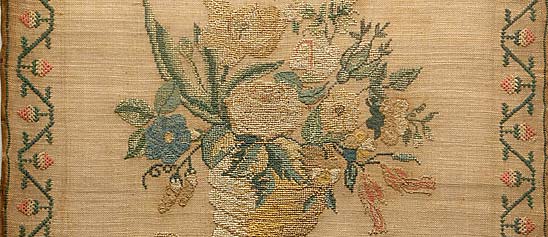
The earliest known American sampler was made by Loara Standish of the Plymouth Colony about 1645. By the 1700s, samplers depicting alphabets and numerals were worked by young women to learn the basic needlework skills needed to operate the family household. By the late 1700s and early 1800s, schools or academies for well-to-do young women flourished, and more elaborate pieces with decorative motifs such as verses, flowers, houses, religious, pastoral, and/or mourning scenes were being stitched. The parents of these young women proudly displayed their embroideries as showpieces of their work, talent, and status.
In recent years, samplers have become important in museum collections as representations of early American female education. Many are signed, and some are inscribed with locations and the names of teachers and schools. The emergence of large numbers of these samplers has resulted in much research in diaries, account books, letters, newspaper ads, local histories, and published commentary that is helping to illuminate the lives of women in early America.
Many early samplers do not have the letters “J” and “U” in their alphabets because they were not part of the early Latin alphabet and so the letter “I” was used for “J” and the “V” for “U.” The letter “s” is often replaced with the printers “s” which looks like the modern f.
There are 137 American samplers in the Textile Collection. The first was donated in 1886, the Margaret Dinsmoor sampler. In the 1890s the Copp Collection was received and it contained two samplers—one by Esther Copp and the other by her great niece Phebe Esther Copp. (The Copp Collection is an extensive collection of 18th-and 19th- century household textiles, costume items, furniture, and other pieces belonging to the Copps, a prosperous but frugal Connecticut family.) The earliest dated sampler in the collection was made in 1735 by Lydia Dickman of Boston, Massachusetts.
Our collection database is a work in progress. We may update this record based on further research and review. Learn more about our approach to sharing our collection online.
If you would like to know how you can use content on this page, see the Smithsonian's Terms of Use. If you need to request an image for publication or other use, please visit Rights and Reproductions.