Art - Overview

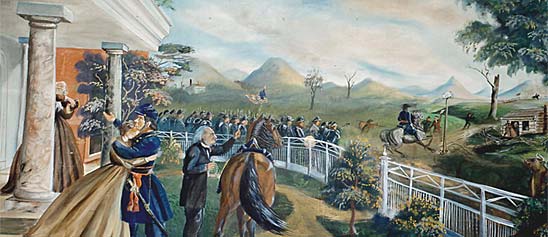
The National Museum of American History is not an art museum. But works of art fill its collections and testify to the vital place of art in everyday American life. The ceramics collections hold hundreds of examples of American and European art glass and pottery. Fashion sketches, illustrations, and prints are part of the costume collections. Donations from ethnic and cultural communities include many homemade religious ornaments, paintings, and figures. The Harry T Peters "America on Stone" collection alone comprises some 1,700 color prints of scenes from the 1800s. The National Quilt Collection is art on fabric. And the tools of artists and artisans are part of the Museum's collections, too, in the form of printing plates, woodblock tools, photographic equipment, and potters' stamps, kilns, and wheels.
"Art - Overview" showing 79 items.
Page 1 of 8
Kelp #3
- Description
- Edward Weston was influential in the modern photography movement beginning in the 1930s. He is well known for photographing the natural surroundings of his home on the California coast. Weston created striking works of art, some abstract, some more traditional images.
- A leader in American photography of the 20th century, Weston's prints were first exhibited at the Smithsonian in 1947. Afterwards, he remained interested in the national photography collection. At times, Weston recommended photographers to curators for collecting opportunities, and eventually donated a selection of his work and several cameras to the History of Photography Collection.
- Location
- Currently not on view
- Date made
- 1936
- photographer
- Weston, Edward
- ID Number
- PG*4980
- accession number
- 210054
- catalog number
- 4980
- Data Source
- National Museum of American History, Kenneth E. Behring Center
Roscoe Holcomb
- Description
- Roscoe Holcomb (1911-1981) embodied the "high, lonesome sound" of traditional Appalachian songs. A banjo player and singer, he spent most of his life in the small town of Daisy, Kentucky, working for a living with no aspirations to become a star. Smithsonian folklorist John Cohen recorded Holcomb at home in 1959. That recording led to performances at bluegrass festivals and an international tour with the Stanley Brothers.
- Location
- Currently not on view
- negative
- 1972
- 2003
- maker
- Horenstein, Henry
- ID Number
- 2003.0169.028
- accession number
- 2003.0169
- catalog number
- 2003.0169.028
- Data Source
- National Museum of American History, Kenneth E. Behring Center
Locomotion, Plate 55 "Walking, Turning Around, Action of Aversion"
- Description
- Eadweard Muybridge's cyanotypes are working proofs (contact prints) made from the more than 20,000 negatives he took at the University of Pennsylvania from 1884 to 1886. There Muybridge photographed human and animal subjects in motion from lateral (parallel), front, and rear positions. For the lateral views he used up to 36 lenses in 12 to 24 cameras placed at 90-degree angles to his subjects. Muybridge added two more cameras, each holding up to 12 lenses and placed at 60-degree angles, for the front and rear "foreshortening" views.
- Since the original negatives no longer exist, the cyanotypes record complete images before Muybridge edited and cropped them for publication. The mounted cyanotypes for plate 55 represent one of over 750 sets of proofs in this unique collection of early photography of motion at the Smithsonian. Comparisons between Muybridge's working cyanotype proofs and his final collotype prints prove that he freely reprinted, cropped, deleted, or substituted negatives to make the assemblage of 781 collotype in the portfolio "Animal Locomotion".
- In plate 55, frame 3 of the rear views is blank and crossed out, indicating a camera malfunction. The remaining 11 frames were reassembled and renumbered for the final print.
- Location
- Currently not on view
- Date made
- 1885-07-28
- maker
- Muybridge, Eadweard
- ID Number
- PG*3856.0049
- accession number
- 98473
- catalog number
- 3856.0049
- Data Source
- National Museum of American History, Kenneth E. Behring Center
Gatemouth Brown
- Description
- Talented on many instruments--guitar, fiddle, harmonica, drums--Clarence "Gatemouth" Brown (1924-2005) was one of the most versatile musicians of his time. Defying easy categorization, Gatemouth said he just wanted to play American music "Texas-style."
- Location
- Currently not on view
- negative
- 1976
- 2003
- maker
- Horenstein, Henry
- ID Number
- 2003.0169.003
- accession number
- 2003.0169
- catalog number
- 2003.0169.003
- Data Source
- National Museum of American History, Kenneth E. Behring Center
Harmonica Frank Floyd
- Description
- Photographed backstage, "Harmonica" Frank Floyd (1908-1984) was an entertainer for the better part of the 20th century. After running away from home at age twelve, he began playing harmonica in carnivals and medicine shows. His repertoire included jokes, tricks, songs, and stories.
- Location
- Currently not on view
- negative
- 1973
- 2003
- maker
- Horenstein, Henry
- ID Number
- 2003.0169.006
- accession number
- 2003.0169
- catalog number
- 2003.0169.006
- Data Source
- National Museum of American History, Kenneth E. Behring Center
Stonewall Jackson
- Description
- Named after his Civil War ancestor, Stonewall Jackson (b. 1932) began performing professionally in the 1950s. Thanks to tour with Ernest Tubb, Jackson had a string of hits from the late 1950s to the mid-1960s.
- Location
- Currently not on view
- negative
- 1972
- 2003
- maker
- Horenstein, Henry
- ID Number
- 2003.0169.008
- accession number
- 2003.0169
- catalog number
- 2003.0169.008
- Data Source
- National Museum of American History, Kenneth E. Behring Center
Loretta Lynn
- Description
- Loretta Lynn is a classic country singer whose life--from her autobiography, Coal Miner's Daughter--is a well-known story. She was one of the first stars to sing with a feminist point of view. Her songs, like "Don't Come Home a-Drinkin' (with Lovin' on Your Mind)" and "The Pill," broke new ground in country music. Lynn (b. 1935) and Conway Twitty were named Vocal Duo of the Year by the Country Music Association for years in a row in the early 1970s.
- Location
- Currently not on view
- negative
- 1971
- 2003
- maker
- Horenstein, Henry
- ID Number
- 2003.0169.011
- accession number
- 2003.0169
- catalog number
- 2003.0169.011
- Data Source
- National Museum of American History, Kenneth E. Behring Center
Dolly Parton and Porter Wagoner
- Description
- Dolly Parton joined Porter Wagoner and the Wagonmasters in 1967. She launched her solo career in 1974.
- Location
- Currently not on view
- negative
- 1972
- 2003
- maker
- Horenstein, Henry
- ID Number
- 2003.0169.018
- accession number
- 2003.0169
- catalog number
- 2003.0169.018
- Data Source
- National Museum of American History, Kenneth E. Behring Center
Ricky Skaggs
- Description
- Henry Horenstein photographed Ricky Skaggs (b. 1954) several times as a member of Emmylou Harris's Hot Band and as a memeber of J. D. Crowe & the New South. A multi-talented singer and instrumentalist, Ricky Skaggs's success helped inspire the new traditionalist movement, and was largely responsible for a back-to-basics movement in country music.
- negative
- 1980
- 2003
- maker
- Horenstein, Henry
- ID Number
- 2003.0169.020
- accession number
- 2003.0169
- catalog number
- 2003.0169.020
- Data Source
- National Museum of American History, Kenneth E. Behring Center
Porter Wagoner
- Description
- One of the most recognizable figures in country music, Porter Wagoner was known as the "Thin Man from West Plains, Missouri." He began recording music in 1954 after several years of singing on a local radio station. In 1961, Wagoner (b. 1927) began to host his own country music television show, which was syndicated for 21 years.
- Location
- Currently not on view
- negative
- 1972
- 2003
- maker
- Horenstein, Henry
- ID Number
- 2003.0169.022
- accession number
- 2003.0169
- catalog number
- 2003.0169.022
- Data Source
- National Museum of American History, Kenneth E. Behring Center

