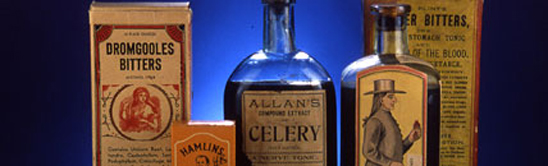
Balm of America: Patent Medicine Collection - History

Origin of Patent Medicines
![]() |
| Hooper's Female Pills |
Many of the earliest English patent medicines, such as Turlington’s Balsam of Life, Bateman’s Pectoral Drops, and Hooper’s Female Pills, were very successful within the American colonies. Some of these medicines survived well into the 20th century, such as Dicey’s Dr. Bateman’s Drops, whose original patent was granted by King George I in1726.
Rise of American Patent Medicines
![]() |
|
Balm of America |
Civil War Taxation
![]() |
| Left: Alden's bottle; Right: Warner's box |
The government returned to patent medicine taxation during the Spanish American War (1898-1902), using a distinctive “battleship” stamp, as seen on the box of Warner’s Safe Asthma Cure.
Golden Age of Patent Medicines
The second half of the 19th century is considered to be the golden age of American patent medicines. Rapid increases in industry and manufacturing, urban living, advertising in national newspapers and magazines, and the absence of drug regulation all contributed to a boom in the production and consumption of patent medicines. Many people turned to patent medicines out of fear and distrust of contemporary medical practices. This was the period of “heroic medicine,” in which extreme techniques such as bloodletting and the use of harsh purgatives and emetics were often employed by physicians. Working before the advent of germ theory at the end of the 19th century, regular physicians had few therapies that could compete with the patent medicine industry’s promise of easy health in a bottle.
Patent Medicine Advertising
![]() |
| Blair's pills |
Patent medicine makers were pioneers in the use of such advertising techniques as solicitation through the mail, the provision of free samples and promotional trinkets, national newspaper campaigns, outdoor signage, and testimonials. Popular patent medicine almanacs (free publications of 30 to 40 pages containing weather forecasts, horoscopes, and household and health advice) offered abundant advertising for the sponsoring companies’ products.
Giveaways, such as a matchbook style needle and thread case from the Lydia Pinkham Company, were also used to boost sales.
Unregulated Industry
![]() |
| Dr. Flint’s Quaker Bitters |
Beginning of Drug Regulation
![]() |
|
Top: Chamberlain's Colic and Diarrhea Remedy; Bottom: May's Health Pearl |
Such exposes helped to promote the first federal Food and Drug Act, signed into law by President Theodore Roosevelt on June 30, 1906. The act was amended in 1912, and an even stronger Food, Drug and Cosmetic Act passed in 1938. These laws required drug labeling to include a list of ingredients and prohibited manufacturers from making false and misleading claims.
From 1906 to 1918 manufacturers could label their products with a “guaranty” that their medicine complied with the new food and drug law. The 1906 law required manufacturers to label their products if any of the following ingredients were present: alcohol, morphine, opium, cocaine, heroin, eucaine, chloroform, cannabis indica, chloral hydrate, or acetanilide. A complete listing of all ingredients was not required until 1938.
Federal food and drug regulation continues to evolve. Amendments to the laws in 1951 established clear distinctions between prescription and over-the-counter drugs. More recently, new regulations have introduced the category of “dietary supplements,” whose health claims must be labeled as “not evaluated by the Food and Drug Administration.” Also, a “Drug Facts” label has been required on all over-the-counter medicines since 2002.
Patent Medicines Today
Despite dramatic changes in medical knowledge and federal regulation in the past 100 years, self-medication continues to be a popular form of treatment for many Americans. Although no longer referred to as “patent medicines,” over-the-counter products today offer an enormous array of choices without requiring the consultation of a physician. Manufacturers of these remedies continue to rely on extensive advertising to reach the consumer directly, employing many of the methods pioneered by patent medicine marketers over 100 years ago.
"Balm of America: Patent Medicine Collection - History" showing 641 items.
Page 5 of 65
Baby Percy Medicine or Dr. McDonald's Celebrated Prescription
- Description
- The indications or uses for this product as provided by the manufacturer are:
- For diarrhea, indigestion, cholera infantum and summer complaints of children. Relieves sour stomach instantly. A safe and reliable teething and colic medicine for babies.
- Location
- Currently not on view
- Date made
- before 1938
- maker
- Merrick Medicine Company
- ID Number
- MG*293320.1181
- catalog number
- 293320.1181
- accession number
- 293320
- Data Source
- National Museum of American History, Kenneth E. Behring Center
Bee Brand White Pine and Tar Cough Syrup Compound
- Description
- The indications or uses for this product as provided by the manufacturer are:
- A splendid medicine for coughs, colds, bronchitis, sore and inflamed throat, hoarseness, loss of voice
- Location
- Currently not on view
- Date made
- after 1930
- maker
- McCormick and Company
- ID Number
- MG*293320.1182
- catalog number
- 293320.1182
- accession number
- 293320
- Data Source
- National Museum of American History, Kenneth E. Behring Center
Beecham's Pills
- Description
- [No indications or uses for this product are provided on its packaging.]
- Location
- Currently not on view
- Date made
- after 1859
- maker
- Beecham's Pills
- ID Number
- MG*293320.1183
- catalog number
- 293320.1183
- accession number
- 293320
- Data Source
- National Museum of American History, Kenneth E. Behring Center
Sirop-Sulfo-Phenique
- Description
- The indications or uses for this product as provided by the manufacturer are:
- Chronic cases of catarrh, asthma, rheumatism, skin diseases
- Location
- Currently not on view
- Date made
- after 1878
- maker
- Declat Manufacturing Company
- J. Milhau's Son
- ID Number
- MG*293320.1277
- catalog number
- 293320.1277
- accession number
- 293320
- Data Source
- National Museum of American History, Kenneth E. Behring Center
Tiz For Tender Feet
- Description
- The indications or uses for this product as provided by the manufacturer are:
- Relieve tired, aching, swollen and sweaty feet, chilblains and frost bites, corns, bunions, ingrown nails and calluses
- Location
- Currently not on view
- Date made
- ca 1920
- maker
- Walter Luther Dodge Company
- ID Number
- MG*293320.1278
- catalog number
- 293320.1278
- accession number
- 293320
- Data Source
- National Museum of American History, Kenneth E. Behring Center
Tropic Fruit Laxative
- Description
- The indications or uses for this product as provided by the manufacturer are:
- Laxative
- Location
- Currently not on view
- Date made
- ca 1885
- maker
- J. E. Hetherington
- ID Number
- MG*293320.1279
- catalog number
- 293320.1279
- accession number
- 293320
- Data Source
- National Museum of American History, Kenneth E. Behring Center
Dr. Tucker No. 59 Cough Drops
- Description
- The indications or uses for this product as provided by the manufacturer are:
- Cure of coughs, colds, sore throat, bronchial affections
- Location
- Currently not on view
- Date made
- ca 1880
- maker
- Dr. H. A. Tucker
- ID Number
- MG*293320.1280
- catalog number
- 293320.1280
- accession number
- 293320
- Data Source
- National Museum of American History, Kenneth E. Behring Center
Mother Seigel's Curative Syrup
- Description
- The indications or uses for this product as provided by the manufacturer are:
- For tonic and alterative effect. Laxative and cathartic.
- Location
- Currently not on view
- Date made
- ca 1900
- after 1880
- maker
- A. J. White, Limited
- ID Number
- MG*293320.1368
- catalog number
- 293320.1368
- accession number
- 293320
- Data Source
- National Museum of American History, Kenneth E. Behring Center
Seabury's Cough Balsam
- Description
- The indications or uses for this product as provided by the manufacturer are:
- For coughs, colds, influenza, croup, whooping cough, asthma, other affections of the lungs and throat leading to consumption
- Location
- Currently not on view
- Date made
- after 1870
- date made
- ca 1898
- maker
- J. S. Seabury
- ID Number
- MG*293320.1369
- catalog number
- 293320.1369
- accession number
- 293320
- Data Source
- National Museum of American History, Kenneth E. Behring Center
Sherman's Worm Lozenges
- Description
- The indications or uses for this product as provided by the manufacturer are:
- Worm lozenge
- Location
- Currently not on view
- Date made
- after 1844
- maker
- A. Sherman, M.D.
- ID Number
- MG*293320.1370
- catalog number
- 293320.1370
- accession number
- 293320
- Data Source
- National Museum of American History, Kenneth E. Behring Center


