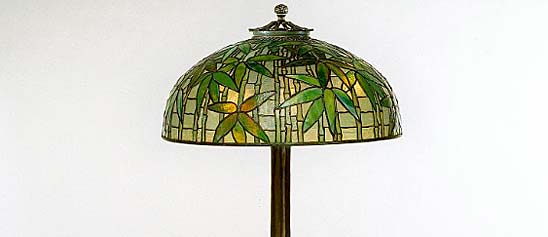
Domestic Furnishings - Overview

Washboards, armchairs, lamps, and pots and pans may not seem to be museum pieces. But they are invaluable evidence of how most people lived day to day, last week or three centuries ago. The Museum's collections of domestic furnishings comprise more than 40,000 artifacts from American households. Large and small, they include four houses, roughly 800 pieces of furniture, fireplace equipment, spinning wheels, ceramics and glass, family portraits, and much more.
The Arthur and Edna Greenwood Collection contains more than 2,000 objects from New England households from colonial times to mid-1800s. From kitchens of the past, the collections hold some 3,300 artifacts, ranging from refrigerators to spatulas. The lighting devices alone number roughly 3,000 lamps, candleholders, and lanterns.
"Domestic Furnishings - Overview" showing 65 items.
Page 1 of 7
1784 Overshot Coverlet
- Description
- The weaver and original owner of this very complex, well worn, single-woven, linen, cotton and wool, overshot coverlet, dated 1784, are unknown. The letters “E M” and the date are woven into the coverlet on the lower right hand side, using a hand technique. We do not know if
- “E M” stands for name of the owner or the weaver. In the 18th century it was not unusual for textiles to be marked with the initials of the owner, but it was usually done with embroidery. The initials identified the coverlet as the woman's property. Women could own and inherit "moveable" property.
- The overall patterns used in this coverlet are “Rose” and “Tables,” and there are two shades of indigo blue used in a band effect. The coverlet was woven in two sections, and then sewn together. The original size of the sections and the coverlet as a whole are unknown, as there are no original edges present. This coverlet was found in Massachusetts. In the18th century, a young woman might commission the weaving of a coverlet or receive one as a gift, and put it in her dowry (hope chest) saving it for use after marriage.
- Location
- Currently not on view
- date made
- 1784
- maker
- unknown
- ID Number
- 1979.0723.1
- accession number
- 1979.0723
- catalog number
- 1979.0723.1
- Data Source
- National Museum of American History, Kenneth E. Behring Center
Overshot Coverlet 1787
- Description
- The date 1787 and the letters “M S” are woven into a corner of this cotton, linen, and wool, single-woven overshot coverlet. The center seam indicates the coverlet was woven in two sections that were sewn together. One section is an inch smaller than the other. The pattern could be a variation of “Kings Flower” pattern or “Roses and Tables.” This Coverlet was found in New York State. It is not known if “M S” are the initials of the weaver or the owner, both of whom are unknown. In the 18th century, household textiles were prized possessions, and it was not unusual for them to be marked with the owner’s initials and the date. However, the marking was usually done with embroidery.
- Location
- Currently not on view
- date made
- 1787
- maker
- unknown
- ID Number
- 1979.0723.2
- accession number
- 1979.0723
- catalog number
- 1979.0723.2
- Data Source
- National Museum of American History, Kenneth E. Behring Center
Linen Overshot Coverlet 1790
- Description
- Elizabeth Deuel is said to have made this single-woven, all linen coverlet in1790, in the Saratoga region of New York State. Her name and the date are cross-stitched into the lower edge of the coverlet just above the fringe. A search of the 1790 census of the area produced no one with the surname Deuel. More research is needed to determine where Miss Deuel lived, and if she was the weaver or the owner of this coverlet. In the 18th century, it was common for household textiles to be marked with the initials or name of the owner and the date. The average colonial home did not have a great number of household textiles, and they were considered important possessions. This coverlet was woven in two sections that were then sewn together.
- Location
- Currently not on view
- date made
- late 18th century
- 1790
- weaver or owner
- Deuel, Elizabeth
- maker or owner of coverlet
- Deuel, Elizabeth
- ID Number
- 1981.0274.005
- accession number
- 1981.0274
- catalog number
- 1981.0274.05
- Data Source
- National Museum of American History, Kenneth E. Behring Center
Rose of Sharon Coverlet
- Description
- The weaver of this single-woven overshot coverlet is unknown. It is made entirely of wool, and was probably woven in the late 18th or early 19th century. The pattern used is similar to the patterns known as “Rose of Sharon” and “Freeman’s Felicity.” It was woven in two sections and sewn together. The lower edge has an applied fringe, while the one on the side is a self fringe. In the 18th and early 19th centuries, it was common for women to spin fiber into yarn, and take the yarn to a professional weaver for use in a coverlet. In the late 18th and early 19th centuries, household textiles were precious belongings, frequently listed in household inventories right along with furniture and tools.
- Location
- Currently not on view
- date made
- 1790-1810
- late 18th century
- early 19th century
- maker
- unknown
- ID Number
- 1981.0274.008
- accession number
- 1981.0274
- catalog number
- 1981.0274.08
- Data Source
- National Museum of American History, Kenneth E. Behring Center
Daniel Pursell Coverlet
- Description
- The patterns seen in this cotton and wool Jacquard double-woven coverlet are “Birds of Paradise,” “Penelope’s Flower Pot,” and “Boston Town." The coverlet may have been made in Ohio by Daniel Pursell in the mid-to-late 1860’s. Mr. Pursell was born in Ohio about 1815. He reportedly lived in Portsmouth, Scott County, Ohio. He is listed in the 1850 Ohio Census as a 35-year-old weaver. When the coverlet arrived at the Museum in 1982, a note was attached to it. It read: “coverlet 110 years old or more 1868 approx. Prob. Made by D.Pursell Ports O-Liberty Raised sheep for wool, Grandm helped twist flax GMa born 1848 married 1871 about 23 years old.”
- Location
- Currently not on view
- date made
- ca 1860s
- maker (possibly)
- Pursell, Daniel
- ID Number
- 1982.0573.001
- accession number
- 1982.0573
- catalog number
- 1982.0573.001
- Data Source
- National Museum of American History, Kenneth E. Behring Center
All Wool Coverlet
- Description
- According to the donor of this coverlet, it first belonged to Mrs. Ferdinand O’Neal, who lived just outside Zanesville, Ohio. Her maiden name is believed to have been Wheeler, and in about 1863 she married Mr. O’Neal and moved to a home outside of Zanesville, known as “Greenwood.” Mrs. O’Neal passed the coverlet on to her daughter Marcella O’Neal, who passed it on to Martha Margaret O’Neal. The coverlet is made entirely of wool, and was probably woven (in two sections) between 1840 and 1860. The pattern is similar to the one known as “Cup and Saucer.” The weaver is unknown.
- Location
- Currently not on view
- date made
- 1840-1860
- maker
- unknown
- ID Number
- 1993.0225.001
- accession number
- 1993.0225
- catalog number
- 1993.0225.01
- Data Source
- National Museum of American History, Kenneth E. Behring Center
Aunt Lizzie Reagan's Coverlet
- Description
- Lizzie Reagan wove this overshot coverlet in Tennessee in about 1930. It is made of cotton and wool, and woven in a design that is sometimes known as "Lee's Surrender." Lizzie Reagan was known as Aunt Lizzie, and was an expert on natural dyes. She was active in the movement to reintroduce "old" methods such as hand spinning and weaving at the Phi Beta Phi Settlement School in Gatlinburg, Tennessee. Such schools were started in the 1880s by benevolent societies in an attempt to encourage and preserve the local material culture, and provide the local artists with income.
- Location
- Currently not on view
- date made
- ca 1930
- maker
- Reagan, Lizzie
- ID Number
- 1996.0120.01
- catalog number
- 1996.0120.01
- accession number
- 1996.0120
- Data Source
- National Museum of American History, Kenneth E. Behring Center
Bassler Coverlet
- Description
- The name "J Bassler", the date 1842, and the letters " W B " are woven into the lower edge of this coverlet. It is not known if "J Bassler " or "W B" was the weaver of the coverlet. The coverlet is Jacquard woven, with red, blue and green stripes. The design features rows of birds and flowers.This coverlet could be considered part of the "Fancy" period in American decorative arts, as the overall design is bright and full of movement.
- Location
- Currently not on view
- date made
- 1842
- maker or owner
- Bassler, J.
- maker
- unknown
- ID Number
- 1998.0081.03
- accession number
- 1998.0081
- catalog number
- 1998.0081.03
- Data Source
- National Museum of American History, Kenneth E. Behring Center
Hausman Coverlet
- Description
- Benjamin Hausman, (1795—1885) of Allentown, Pennsylvania, wove this cotton and wool Jacquard double-woven coverlet for Jane Paul in 1841. His name and hers appear in the lower corners along with the date. The coverlet is Jacquard double-woven with floral medallions and stars, as the overall pattern, and with a border of trees and flowers. It has no center seam. Several members of the Hausman family were coverlet weavers in Pennsylvania in the 19th century. Benjamin worked in Allentown, Lehigh County, from 1836 to 1845, and in York, York County, from 1847 to 1848. He appears to have moved to Philadelphia in 1852, but is listed as a coverlet weaver in the 1850 census of York, York County, Pennsylvania.
- Location
- Currently not on view
- date made
- 1841
- owner of coverlet in 19th century
- Paul, Jane
- maker
- Hausman, Benjamin
- ID Number
- TE*E.393749
- accession number
- 211601
- catalog number
- E.393749
- Data Source
- National Museum of American History, Kenneth E. Behring Center
Overshot Copp Coverlet
- Description
- This cotton and wool overshot coverlet in red, green, and white is part of the Copp collection of late 18th-and early 19th-century, costume and household textiles given to the Museum in the late 19th century by John Brenton Copp of Stonington, Connecticut. The Copps were a middle- class family of merchants and businessmen who first settled in America in 1635. They imported items for their shop from England, Europe, and India, and engaged in the home production of textiles as well. This single-woven coverlet was made in the early 19th century, and the overall design is similar to the one known as “Worlds Wonder.” The use of the color green is interesting, as there were no direct green dyes until the discovery of synthetic dyes in the middle of the 19th century. Before that time, when the color green was wanted, yarns or fabric would first be dyed blue and then yellow, using natural dyes. The weaver of this coverlet is unknown.
- Location
- Currently not on view
- date made
- 1800-1825
- maker
- unknown
- ID Number
- TE*H006674
- catalog number
- H006674.000
- accession number
- 028810
- Data Source
- National Museum of American History, Kenneth E. Behring Center

