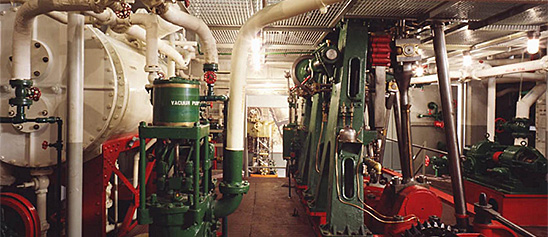
Engineering, Building, and Architecture - Overview

Not many museums collect houses. The National Museum of American History has four, as well as two outbuildings, 11 rooms, an elevator, many building components, and some architectural elements from the White House. Drafting manuals are supplemented by many prints of buildings and other architectural subjects. The breadth of the museum's collections adds some surprising objects to these holdings, such as fans, purses, handkerchiefs, T-shirts, and other objects bearing images of buildings.
The engineering artifacts document the history of civil and mechanical engineering in the United States. So far, the Museum has declined to collect dams, skyscrapers, and bridges, but these and other important engineering achievements are preserved through blueprints, drawings, models, photographs, sketches, paintings, technical reports, and field notes.
"Engineering, Building, and Architecture - Overview" showing 49 items.
Page 1 of 5
Post Instruction Manual for Versalog Slide Rule
- Description
- This is a later printing of 1978.0800.02. Its citation information is: E. I. Fiesenheiser, Versalog Slide Rule Instruction Manual, with R. A. Budenholzer and B. A. Fisher (Chicago: Frederick Post Company, 1963). The text appears not to have been revised since these three Illinois Institute of Technology engineering professors helped invent the Versalog slide rule and wrote instructions for using it in 1951. Marks inside the front cover indicate this copy was offered for sale in January 1969 for $1.00.
- Location
- Currently not on view
- date made
- 1963
- maker
- Frederick Post Co.
- ID Number
- 1980.0097.03
- accession number
- 1980.0097
- catalog number
- 1980.0097.03
- Data Source
- National Museum of American History, Kenneth E. Behring Center
Dietzgen D1803D Compensating Polar Planimeter
- Description
- This metal polar planimeter has a white plastic measuring wheel with vernier and a metal registering dial on the 5" tracer arm. The tracer arm is marked on top: DIETZGEN (/) MADE IN U.S.A. Next to the tracer point, it is marked: 22812. The other arm is 8" long and screwed to a cylindrical metal weight.
- A beige plastic case is lined with deteriorating gray foam padding. A label inside the case is marked: DIETZGEN (/) PLANIMETER No. D1803D (/) TEST RULE 12.50 SQ. IN. Serial No. 22812. A chart has columns for Scale, Value of unit of vernier, Constant: Pole inside figure, and Pole Arm Setting. Only the first row of the chart (for the scale 1" = 100') is completed. The case fits inside a beige cardboard box with a black, yellow, and white label: DEITZGEN One Only (/) Compensating (/) POLAR PLANIMETER (/) In Velvet Lined Case, with Testing Rule (/) and Directions D1803D.
- In the 1920s, the Eugene Dietzgen Company of Chicago sold a planimeter similar to this one as model 1804. By the 1950s, the planimeter was renumbered to model D1803D and offered in the wooden case with velvet lining mentioned on the label on this example. Later, the plastic and foam case replaced the wooden case. "Dietzgen" is stamped rather than printed on the label inside this case, suggesting that another company made the planimeter and Dietzgen distributed it. This object was found in the Museum in 1984.
- Reference: Catalog of Eugene Dietzgen Co., 12th ed. (Chicago, 1926), 182.
- Location
- Currently not on view
- date made
- ca 1960
- maker
- Eugene Dietzgen Company
- ID Number
- 1987.0107.09
- accession number
- 1987.0107
- catalog number
- 1987.0107.09
- Data Source
- National Museum of American History, Kenneth E. Behring Center
Pickett N4-ES Vector-Type Log Log Duplex Slide Rule
- Description
- This aluminum ten-inch linear duplex slide rule is coated in Pickett's "Eye Saver" yellow plastic. The flat nylon indicator is screwed within a white plastic frame. The front top of the base has three extended cube root scales (one for numbers with 1, 4, 7, 10, or more digits before the decimal point; one for numbers with 2, 5, 8, 11, or more digits; and one for numbers with 3, 6, 9, 12, or more digits) and a DF scale. The front bottom of the base has D, DI, and square root scales. The top square root scale gives roots of numbers on the D scale with an odd number of digits before the decimal point; the lower square root scale gives roots of numbers with an even number of digits. The front of the slide has CF, CIF, double T, ST, S, CI, and C scales.
- The left end of the slide is marked: MODEL N4-ES (/) Vector-Type LOG LOG (/) DUAL-BASE SPEED RULE. The right end has "Pickett" in script on a triangle with a dot at one point. MADE IN U.S.A. appears beneath the logo. This form of logo was in use from 1958 to 1962. The style of the grooved stamped aluminum posts is also consisted with this timeframe.
- The top back of the base has LL1, LL2, and DF/M scales. D, LL3, and LL4 scales are on the bottom of the base. The back of the slide has CF/M, TH, SH, Ln, L, CI, and C scales. The back of the slide is marked at the left end: COPYRIGHT 1959© (/) PATENT APPLIED FOR. The right end is marked: PICKETT (/) ALL METAL (/) SLIDE RULES (/) PICKETT & ECKEL INC. (/) CHICAGO ILL. U.S.A. The mention on the instrument of a patent application may refer to a patent for a case issued to John W. Pickett in 1960. Pickett was the son of company founder Ross C. Pickett and served as president of the firm from 1957 to 1967.
- The slide rule is in a red-brown leather case lined in white plastic. The triangular Pickett logo is stamped in gold on the front of the case, and a metal ring on the back is for a leather strap (no longer with the instrument) that can be hung around a belt loop. See 1980.0097.04 for instructions.
- The donor, engineer Edgar F. Peebles, obtained this slide rule free of charge as a replacement when the numbers came off the slide rule he had used in college. He first used it from 1959 to 1965 in the satellite control facility of the Air Force at Sunnyvale, Calif. He then used it as a down range representative for Lockheed Missiles and Space Company from 1965 to 1968 in tests of the Polaris missile. Finally, from 1968 to 1969 he used the slide rule in the checkout area of the test Polaris missile manufacturing plant in Sunnydale.
- References: Rodger Shepherd, "Pickett's 'Eye Saver Yellow,'" Journal of the Oughtred Society 1, no. 1 (1992): 18; International Slide Rule Museum, "Pickett All-Metal Slide Rules," http://sliderulemuseum.com/SR_Dates.htm#Pickett; Maurice L. Hartung, How to Use . . . Pickett Dual Base Log Log Slide Rules (Chicago: Pickett & Eckel, Inc., 1953), http://sliderulemuseum.com/Manuals/M103_Pickett_HowToUseDualBase_1953.pdf; John W. Pickett, "Slide Rule Case" (U.S. Patent D187,632 issued April 5, 1960); accession file.
- Location
- Currently not on view
- date made
- ca 1959
- maker
- Pickett & Eckel, Incorporated
- ID Number
- 2000.0203.01
- accession number
- 2000.0203
- catalog number
- 2000.0203.01
- Data Source
- National Museum of American History, Kenneth E. Behring Center
Post Instruction Manual for Versalog Slide Rule
- Description
- In 1950 and 1951, three Illinois Institute of Technology engineering professors participated in the development of the Versalog slide rule, manufactured by Hemmi of Tokyo, Japan, for the Frederick Post Company of Chicago. E. I. Fiesenheiser, R. A. Budenholzer, and B. A. Fischer subsequently prepared this 115-page hardcover volume explaining the slide rule's capabilities. They covered the care of the instrument, its twenty-three scales, multiplication and division, squares and cubes, exponentials and logarithms, and trigonometric operations. Each professor also contributed a chapter on applications in his specialty: civil, mechanical, or electrical engineering.
- This copy is stamped inside the front cover and on the edges: WILLIAM KRUTZ ESQ. See 1978.0800.01.
- Reference: E. I. Fiesenheiser, The Versalog Slide Rule: An Instruction Manual (Chicago: The Frederick Post Company, 1951), http://sliderulemuseum.com/Manuals/M34_Post_Versalog_1951.pdf.
- Location
- Currently not on view
- date made
- 1951
- publisher
- Frederick Post Co.
- maker
- Frederick Post Co.
- ID Number
- 1978.0800.02
- accession number
- 1978.0800
- catalog number
- 1978.0800.02
- Data Source
- National Museum of American History, Kenneth E. Behring Center
Dietzgen 1735 Maniphase Multiplex Vector Slide Rule
- Description
- This two-sided, ten-inch wooden slide rule is coated with yellowed plastic and has metal endpieces. A glass indicator is cracked on both sides and has metal and black plastic edges marked: DIETZGEN. On one side, the base has L, LL1, DF, D, LL3, and LL2 scales, with CF, CIF, LCI, and C scales on the slide. The top of the base is marked in red: DIETZGEN MANIPHASE MULTIPLEX VECTOR TYPE LOG-LOG RULE CAT. NO. 1735.
- On the other side, the base has LL0, LL00, A, D, Th, Sh2, and Sh1 scales, with B, T, ST, and S scales on the slide. The top of the base is marked: EUGENE DIETZGEN CO. PATS. 2,170,144 2,285,722 MADE IN U.S.A. 108821. The top edge of the rule is marked in script: Dom Petrone. The bottom edge is marked: DP.
- An orange leather case is marked on the flap: K+E. The front of the case is marked: P. Inside the flap is marked: GWU (/) Gerald (/) PETRONE (/) U of Md (/) Easton MD (/) MIT (/) PETRONE, RA. Lines 1–3, 4–5, and 6–7 are each in different inks and handwriting.
- The Eugene Dietzgen Company of Chicago offered model 1735 from 1941 to 1952. "Maniphase" refers to an arrangement of scales in which the company added K and CI scales to Mannheim rules; the word is printed on several slide rules sold by the Eugene Dietzgen Company. This rule is similar to 1986.0790.01, but it has hyperbolic tangent and sine scales on the back of the base instead of DI and K scales.
- Three U.S. Naval Academy professors applied for the patents mentioned on this slide rule in 1937 and 1938. These patents dealt with arranging and coloring scales so that problems could be solved in the fewest steps; they were also cited on Keuffel & Esser slide rule models 4080 and 4801. (See 1992.0437.01, 2007.0181.01, MA*318482, MA*334387, 1990.0687.01, and 1986.0790.03.)
- According to the donor, the rule was purchased by his uncle, Rocco Anthony Petrone (1926–2006), while he was studying for a master's degree in mechanical engineering at the Massachusetts Institute of Technology in 1950 and 1951. After graduation he developed rockets for the U.S. Army. From 1966 to 1975, Petrone held various leadership positions at NASA, including director of the Apollo program (1969–1973).
- Petrone passed the slide rule on to his brother, Dominic J. Petrone, who earned a BS in electrical engineering from Union College in 1950. Dominic gave the rule to his son, Gerald Petrone, who studied engineering at George Washington University in 1969 and subsequently at the University of Maryland at College Park. Gerald broke the indicator and acquired the replacement now on the instrument. He then passed the instrument to his brother, donor David Petrone, who studied electrical engineering at UMCP from 1971 to 1974. At some point, the original case was also replaced with a case from Keuffel & Esser. Several of the Petrones who used the slide rule marked it or the case with their name or initials.
- References: Bruce Babcock, "Dietzgen Catalog Matrix," Journal of the Oughtred Society 5, no. 2 (1996), http://sliderulemuseum.com/Manuals/Dietzgen_CatalogMatrix_BruceBabcock1996_chart.jpg; William K. Robinson, "Slide Rules with Hyperbolic Functions," Journal of the Oughtred Society 14, no. 1 (2005): 55–62; Robert Otnes, "Dietzgen Patents, Runners, and Log Log Scales," Journal of the Oughtred Society 5, no. 2 (1996): 45–48; Lyman M. Kells, Willis F. Kern, and James R. Bland, "Slide Rule" (U.S. Patent 2,170,144 issued August 22, 1939), and "Slide Rule" (U.S. Patent 2,285,722 issued June 9, 1942); accession file; "Candidates for Union College Degrees," Evening Recorder, Amsterdam, N.Y. (June 8, 1950), 5.
- Location
- Currently not on view
- date made
- 1950-1951
- maker
- Eugene Dietzgen Company
- ID Number
- 2013.0040.01
- accession number
- 2013.0040
- catalog number
- 2013.0040.01
- Data Source
- National Museum of American History, Kenneth E. Behring Center
Sunstone Capital
- Description
- Inspired by a vision described by Joseph Smith, the founder of the Church of Jesus Christ of Latter-day Saints (the Mormons), this celestial limestone carving was one of thirty that adorned a grand temple built at Nauvoo, Illinois, in the 1840s.
- In 1844 an anti-Mormon mob murdered Smith, destroyed the temple, and drove the congregation out of Nauvoo. The Mormon community relocated to Utah, where it flourished in the isolation of the West.
- Date made
- 1846
- associated dates
- 1844
- architect
- Weeks, William
- associated institution
- Church of Jesus Christ of Latter-day Saints
- associated person
- Smith, Joseph
- maker
- Weeks, William
- ID Number
- 1989.0453.01
- catalog number
- 1989.0453.01
- accession number
- 1989.0453
- Data Source
- National Museum of American History, Kenneth E. Behring Center
- No Image Available
[Trade catalogs from R. G. Bock Engineers]
- Date
- 1900s
- Company Name
- R. G. Bock Engineers
- Record ID
- SILNMAHTL_8117
- Data source
- Smithsonian Institution Libraries
- No Image Available
[Trade catalogs from Albert Ramond and Associates Inc.]
- Date
- 1900s
- Company Name
- Albert Ramond and Associates Inc.
- Record ID
- SILNMAHTL_8844
- Data source
- Smithsonian Institution Libraries
- No Image Available
[Trade catalogs from Construction Aggregates Corp.]
- Date
- 1900s
- Company Name
- Construction Aggregates Corp.
- Record ID
- SILNMAHTL_11192
- Data source
- Smithsonian Institution Libraries
- No Image Available
[Trade catalogs from V. D. Simons, Inc.]
- Date
- 1900s
- Company Name
- V. D. Simons, Inc.
- Record ID
- SILNMAHTL_19707
- Data source
- Smithsonian Institution Libraries

