Mathematical Charts and Tables - Tables for Monetary Transactions

Tables for Monetary Transactions
American merchants, bankers, and employers have used a wide range of tables to ensure the accuracy of monetary transactions. Some of these tables were produced for stand–alone use, while others were designed to aid those calculating with machines.
As early as 1812, Joseph Jelleff of New York State patented a disc with printed scales used for interest calculations. Versions of this instrument sold at least into the 1830s. William B. Leavitt of New Hampshire copyrighted a similar wooden instrument in 1845. A few years later, Samuel S. Young of Ohio patented a linear instrument for interest calculations. In 1867, Albert Pierson of New Jersey patented a rather different device, in which the tables were mounted on rotating prisms, for the same purpose. Manufacturers of computing machines, such as Felt & Tarrant Manufacturing Company of Chicago and the Marchant Calculating Machine Company of California distributed interest tables to assist those using their products.
Those assessing and paying taxes also used tables. In 1879, Robert Levin Mudd, a county clerk in Illinois, patented a device to ease the work of correctly accessing taxes. In the 1930s, New York entrepreneurs introduced the Costometer, which was designed in part to assist in calculating newly introduced Social Security taxes. Tables also were used for computing both markups and discounts on goods sold, and for finding the total cost of sales, as when multiplying the rate of shipping freight per pound by the number of pounds shipped. Sometimes it is unclear precisely why units used were chosen, as in a handwritten multiplication table collected from a Massachusetts manufacturer of shuttles for looms.
"Mathematical Charts and Tables - Tables for Monetary Transactions" showing 10 items.
Patent Revolving Interest Table
- Description
- In the early 19th century, Joseph Jelleff of Butternuts, New York, and Gilbert D. Lowe of Hampfield, Pennsylvania, took out patents for mathematical tables that eased calculations of interest. This instrument is a version of their inventions, probably made after their patents had expired.
- The instrument consists of two overlapping concentric discs held together with a metal pivot at the center and attached to a cardboard cover. It is designed for finding the interest on a principal of up to $5,000 at an interest rate of six percent, for times ranging from one to thirty days and then from two months to twelve months. Amounts of principal ranging from $1 to $5,000 are listed on the top disc, going out from the center. Next to this list is a notch in the disc that reveals the disc below. Printed on the lower disc, also going out from the center, are amounts of interest for a given length of time. Lengths of time are marked around the edge of the top disc. Rotating an index on the lower disc so that it points to the appropriate time turns that disc so that the correct amounts of interest are shown in the notch.
- A mark on the front of the rotating disc reads: PATENT Revolving Interest TABLE. Another mark there reads: Published by C.M.Riley Cincinnati, Ohio. A mark on the inside of the cover reads: Cost [/] $1.00. Another mark there reads: John F. Kern (/) Germantown (/) September 30th 1839. John F. Kern was a shopkeeper in Germantown, Ohio.
- Compare 1980.0588.02.
- References:
- L.C. Karpinski, Bibliography of Mathematical Works Printed in America through 1850, New York: Arno Press, 1980, pp. 206-207. This describes Jelleff’s Patent Revolving Interest Table
- Joseph Jelleff, “Circular Interest Table,” U. S. Patent (no number), September 8, 1812. Apparently no copy of the patent survives.
- Gilbert D. Lowe, “Circular or Revolving Interest Table,” August 12, 1815. Apparently no copy of the patent survives.
- Location
- Currently not on view
- date made
- 1839
- maker
- Riley
- ID Number
- 2001.0125.01
- catalog number
- 2001.0125.01
- accession number
- 2001.0125
- Data Source
- National Museum of American History, Kenneth E. Behring Center
Leavitt Calculating Disc
- Description
- Printed tables have long offered bankers, businesspeople, and customers a way to calculate interest. This example consists of two interest tables, printed on paper, arranged radially and pasted to the two sides of a pine disc. A slotted piece pivoted at the center of the disc rotates, so that one can select the appropriate column of the tables. The first table gives the interest on sums ranging from 2 cents to $1,000 at a rate of 6 percent, for periods of from 1 to 7 days, 1 to 11 months, and 1 year. The second table gives the total value of an amount compounded at 6% annually for periods of 1 to 6 years.
- A mark on the front and the back reads: Entered according to act of Congress, in the Year 1845, by Wm. B. LEAVITT, in the Clerk’s Office of the District Court of New Hampshire. A mark on the front reads: Stereotyped by Morrill, Silsby & Co.
- William B Leavitt is probably the astronomer and almanac author William B. Leavitt (1812–1895) of North Grantham, New Hampshire. He studied with his uncle, Dudley Leavitt, and took over Dudley’s popular almanac when he died in 1851. William B. Leavitt carried out the calculations for Leavitt’s Almanac until his own death.
- Reference:
- “Life Sketches of Leading Citizens of Merrimack and Sullivan Counties, New Hampshire,” Biographical Review vol. 22, Boston: Biographical Review Publishing Company, 1897, p. 475.
- Location
- Currently not on view
- date made
- ca 1845
- maker
- Leavitt, William B.
- ID Number
- 1980.0588.02
- catalog number
- 1980.0588.02
- accession number
- 1980.0588
- Data Source
- National Museum of American History, Kenneth E. Behring Center
Mathematical Table, Pierson Machine For Calculating Interest
- Description
- In the 19th century, several American inventors devised moving tables that allowed one to calculate interest. This is the U.S. Patent Office model for a device designed to calculate the amount of interest upon any amount less than one thousand dollars for any number of days less than eighty-five at two rates, six and seven percent. It was invented by Albert C. Pierson of Rahway, New Jersey.
- The instrument has three ten-sided rotating prisms, with the sides of each prism marked at the top with the digits from 0 through 9. The rightmost prism represents units, the middle one tens, and the leftmost hundreds in the amount of money borrowed or lent. Each side of each prism has two columns of 84 numbers, corresponding to interest charges for 1 to 84 days. The left column has interest charged at 6%, the right at 7%. Setting the prisms to the correct amount and then summing the numbers on the three prisms for the appropriate number of days gives the interest. A rotating strip on the left allows one to determine the number of days between two dates of the year.
- This is the model for the first of two patents taken out by Albert C. Pierson (probably 1836–1870). Both relate to calculation.
- Reference:
- A. C. Pierson, “Improvement in Calculating Machines,” U.S. Patent 62,882, March 12, 1867 (the machine illustrated by this model).
- A. C. Pierson, “Improvement in Calculating Machines,” U.S. Patent 73,995, February 4, 1868.
- Location
- Currently not on view
- date made
- 1867
- patentee
- Pierson, Albert C.
- maker
- Pierson, Albert C.
- ID Number
- MA*252689
- catalog number
- 252689
- accession number
- 49064
- Data Source
- National Museum of American History, Kenneth E. Behring Center
Rotating Mathematical Table, Sinclair's Freight Computer
- Description
- By the late 1860s, railroads were vital to American commerce. This is the U.S. patent model for a rotating multiplication table used to compute freight charges. It was patented by Albert Sinclair of West Waterville, Maine, in 1869.
- The instrument has a cylindrical metal case painted black, with metal feet at each end. The case contains a rotating cylinder covered with a printed table of numbers, which represent amounts charged for shipping given quantities of freight at given rates. A long narrow opening across the case shows one line of this table. The rate charged (from 1 to 50 cents per hundred pounds) is given at the far left of the table, with total fees indicated for weights from 1 to 9, 10 to 100 (by tens), 200 to 1,000 (by hundreds), and 10,000 to 50,000 (by ten thousands) pounds. A paper sticker glued above the window lists these weights, as well as the cost of shipping the weights for rates of 1/4 cents, 1/2 cents, and 3/4 cents per hundred pounds. Such costs are added on to the figure shown in the table if the rate is not a whole number.
- A blue paper sticker pasted to the case below the window gives instructions. A mark on it reads: SINCLAIR'S FREIGHT COMPUTER (/) FOR RAILROADS AND GENERAL FREIGHTING BUSINESS, (/) By the use of which, all multiplication and division in computing Freight is dispensed with. A reward of Ten Dollars is offered to the first person who can find an error of one cent in the computation of this machine or table.
- Albert Sinclair also took out a patent for a broom earlier in 1869. The 1870 U.S. Census lists an Albert Sinclair, boardinghouse keeper, living in Lewiston, Maine, with his wife, Martha, and several children. Lewiston is about fifty miles southwest of Waterville. The 1860 census lists this Albert Sinclair and his family as living in Kalmar, Minnesota, where he was a farmer, thirty-nine years old, and born in Maine.
- References:
- U.S. Census records.
- Albert Sinclair, “Broom,” U.S. Patent 92,483, July 13, 1869.
- Albert Sinclair, “Improvement in Price-Calculating Devices,” U.S. Patent 97,974, December 14, 1869.
- Location
- Currently not on view
- date made
- 1869
- patentee
- Sinclair, Albert
- maker
- Sinclair, Albert
- ID Number
- MA*252696
- accession number
- 49064
- catalog number
- 252696
- patent number
- 97974
- Data Source
- National Museum of American History, Kenneth E. Behring Center
Mudd's Tax Calculator
- Description
- Doing the calculations associated with tax collection has inspired inventors from at least the 1600s, when the French mathematician and philosopher Blaise Pascal invented an adding machine for that purpose. In 1879 Robert Levin Mudd (1837–1910), the county clerk in Bond County, Illinois, patented this tax calculator. It has sliding tables for calculating the tax due on property worth up to $10,000, at rates of 3 cents, 5 cents, and 25 cents per $100 value. Other columns give the total tax due if assessments are made at several rates for different projects. The instrument folds and fits neatly into a wooden case. This example is incomplete. Compare to U. S. patent 213234, dated March 11, 1879.
- Location
- Currently not on view
- date made
- 1879
- maker
- Mudd, Robert Levin
- ID Number
- 2009.3027.01
- nonaccession number
- 2009.3027
- catalog number
- 2009.3027.01
- Data Source
- National Museum of American History, Kenneth E. Behring Center
Mathematical Tables for Use with a Comptometer
- Description
- The manufacture of computing devices has been associated with mathematical tables at least since the 17th century, when tables of logarithms were used in the manufacture of slide rules. In the mid-19th century, the need for new astronomical tables reportedly inspired the Englishman Charles Babbage to propose a difference engine, which was to print the tables it calculated. The Swedes Georg and Edvard Scheutz actually completed such a machine, and it was used to compute and print tables at the Dudley Observatory in Albany, New York.
- The commercially successful adding and calculating machines introduced in the 19th and 20th centuries were used to produce a wide range of tables. At the same time, machine manufacturers supplied their customers with printed tables to assist in routine calculations. These often involved reducing non-metric measurements to decimal portions of a given unit, as these tables suggest.
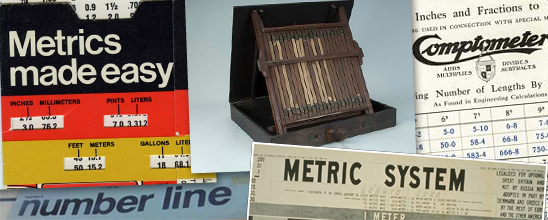
- These six tables, printed on cardboard, were produced for Felt & Tarrant Manufacturing Company of Chicago, manufacturers of an adding machine called the Comptometer. The copyright dates range from 1913 to 1925. All the tables have a photograph of a Comptometer in the upper left corner. Two show the hand and wrist of an operator wearing a suit (presumably a man), and two show the hand and wrist of an operator with a woman’s ring on her finger.
- The first table, Felt & Tarrant’s Form No. 8, illustrates the enduring importance of nonmetric measures in American life. It assists in multiplying the number of lengths by a unit length in engineering calculations. The table gives 10, 100, and 1,000 times inches and fractions of an inch to eighths of an inch. Results are given in feet, inches, and fractions of an inch. The table has no copyright date.
- The second table, Felt & Tarrant’s Form No. 36, was prepared by one U. S. Edgerton, the only author mentioned on the tables. It was copyrighted in 1913 and is for computing interest, insurance cancellation and discounts, with months and days expressed in decimal equivalents of a year. One side shows a year of twelve 30-day months (360 days total). The other side has a table for days only, that runs from 1 to 364.
- The third table, copyrighted in 1914 and 1915, is Felt & Tarrant’s Form 38. It was designed for the textile industry. Entries allow one to reduce drams (of which there 16 to an ounce) and ounces (of which there are 16 to a pound) to decimal portions of a pound. The table has rows for 0 to 15 drams and columns for 0 to 15 ounces.
- The fourth table, Felt & Tarrant’s Form 26, was copyrighted in 1917. It indicates the decimal part of a year represented by each date of the month.
- The fifth table, Felt & Tarrant’s Form No. 368, shows the decimal equivalents of fractions from thirds to 26ths inclusive. It has no copyright date.
- The final table, Felt & Tarrant’s Form No. 386, has measurements in inches, to eighths of an inch, given as decimal portions of a foot. Copyrighted in 1925, it assisted in calculations relating to lumber, steel beams, and angles.
- For another table used with the Comptometer, see 2011.3049.01.
- Location
- Currently not on view
- date made
- 1913-1925
- maker
- Felt & Tarrant Manufacturing Company
- ID Number
- 1979.3074.09
- nonaccession number
- 1979.3074
- catalog number
- 1979.3074.09
- Data Source
- National Museum of American History, Kenneth E. Behring Center
Rotating Multiplication Table
- Description
- This device is a rotating multiplication table. It consists of a wooden box containing a cylinder of sheet steel, which is rotated by turning a metal knob on the left side. A lid at the front of the box opens to reveal rows of numbers on a paper table pasted to the cylinder, and a paper strip with three horizontal rows of numbers pasted to the box in front of the cylinder. The numbers are handwritten in pen.
- The leftmost numbers on the cylinder, indicated in red, increase from 1 to 75 as a knob on the side is rotated. The numbers in the top row, also indicated in red, increase from .05 5/11 to .35. From .05 5/11 through .10, these numbers increase by about .018 from one column to the next (each number at the head of a column is .01 9/11 larger than the previous one. Thus the second column has the heading .07 3/11), and from .10 through .35 they increase by .0125. The three rows of numbers on the sheet attached to the box are labeled 1/1, 1/2, and 1/4. Entries in the table are in black ink, and represent the product of the number in the uppermost row by that in the leftmost column, rounded off to the nearest hundredth (e.g., to cents). What the numbers in the table signify is unclear.
- The instrument was collected in 1966 from Howard S. Pellatt, President of Dudley Shuttles. Dudley Shuttles was the descendent of a firm founded in 1825 in Wilkinsonville, Massachusetts, that made wooden shuttles for textile mills.
- Compare MA*389100.
- Location
- Currently not on view
- ID Number
- MA*328416
- accession number
- 272524
- catalog number
- 328416
- Data Source
- National Museum of American History, Kenneth E. Behring Center
Marchant Tables
- Description
- This notebook contains examples of eighty-odd mathematical tables on cards, as published and distributed by Marchant Calculating Machine Company and its successor firm, Smith Corona Marchant. Copyright dates on the tables range from 1937 through 1958. Most of the tables are listed at the front of the book in an undated three-page “Index of Current Marchant Tables.”
- This listing divides the tables into nineteen categories. These include interest, reverse interest, decimal equivalents, time, two forms of discount, mark-ups, and payroll. Specialized tables relate to insurance, lumber, petroleum and petroleum oils, and foreign exchange. Also included are tables for such mathematical functions as square roots, cube roots, fifth roots, trigonometric functions, and interpolation. Most of the tables are printed. Two tables of natural trigonometric functions, produced in 1941 from work of R. A. Davis, are reproduced from handwritten entries.
- The last table in the series is entitled “Table of 5-Point Lagrangean [sic] Interpolation Coefficients.” This is an advance copy of a portion of a more extensive set of tables then in preparation by the Mathematical Tables Project of the Works Projects Administration for the City of New York. This table runs for several pages. It is based on a table issued by the War Department in June 1941, but is undated.
- Reference: I. I. Rhodes and H. E. Salzer,”Errata - R. A. Davis, Table of Sines and Radians, Oakland, California, 1941, Mathematical Tables and Other Aids to Computation, 1, 1943, p. 124.
- Location
- Currently not on view
- date made
- 1937-1958
- maker
- Marchant Calculators
- ID Number
- 1979.3084.095
- nonaccession number
- 1979.3084
- catalog number
- 1979.3084.095
- Data Source
- National Museum of American History, Kenneth E. Behring Center
Costometer Rotating Mathematical Tables
- Description
- The Costometer is a set of mounted mathematical tables designed to allow a payroll clerk who knows an employee's rate of pay and hours worked to simultaneously find his or her total weekly wage, deductions for federal and state unemployment taxes, deductions for Social Security taxes, and the net pay after deductions. The device was introduced in 1936 to assist business computing payrolls in the wake of the U.S. Social Security Act. It was copyrighted that year by Dean Babbitt and LeRoi E. Hutchings, with contributions to the design by Herbert Austin Brown.
- The instrument has an iron frame painted black and rotating paper tables on a continuous loop. Fabric and a metal plate cover much of the tables. A sliding window associated with each table is moved across it to select the column of numbers to be used. Numbers along the edges of the windows assist in reading the tables. In the center of the sliding plate is a face that represents 60 minutes and 12 hours, presumably to aid in converting time to metric units. A central dial rotates 360 degrees and is numbered from 0 to 9. Cranks for moving the tables are on the sides (one of 4 cranks is missing in this example). A switch for an electric motor is on the left side. The machine has a dust cover.
- A mark on a plate on the front reads: Costometer (/) Corporation (/) New York, N.Y. (/) Made in United States of America. A mark on a small plate at the base of the back reads: A100Z1019. A mark on the tables reads: Copyright 1936 by Dean Babbitt and L.E. Hutchings. A mark on the front toward the back reads: Costometer (/) PATENT PENDING.
- No patent corresponding to this object has been found. This example came to the Smithsonian from the collection of Victor Comptometer Corporation, and quite probably was originally in the collection of Felt & Tarrant Manufacturing Company.
- References:
- “Mechanical Calculation Moves On,” Scientific American, 156 (February 1937): p. 114.
- “Business Opportunities,” New York Times, August 30, 1936, p. F10. The same ad ran on the same page September 6, 1936.
- Location
- Currently not on view
- date made
- ca 1937
- maker
- Costometer Corporation
- ID Number
- MA*323623
- accession number
- 250163
- catalog number
- 323623
- Data Source
- National Museum of American History, Kenneth E. Behring Center
Discount Table for Use with a Comptometer
- Description
- Manufacturers of adding and calculating machines distributed a variety of printed mathematical tables for users of their products. This example, printed in black on white cardboard, was prepared by Felt & Tarrant Manufacturing Company of Chicago, makers of the Comptometer adding machine. It was their Form No. 4 and lists the net result as a decimal of taking off two discounts in percent on an item sold. For example, the table indicates that if an item was selling at a 40% discount and then had an additional 10% discount on the price, the net price would be .54 times the original price. It was for use with a Comptometer. The form shows a Model J Comptometer, a machine produced in the late 1920s and early 1930s. Hence the date assigned.
- A mark at the top of the table reads: Discount Table (/) showing net of $1.00 after discounts, shown (/) at top and side, are taken off (/) to be used in connection with the (/) COMPTOMETER (/) (TRADE MARK).
- According to the donor, the table belonged to her aunt, the late Bessie Gold, who used it with a Burroughs calculator. Born in Russia about 1912, Gold came to the United States as a child. As an adult, she did office work in Richmond, Va.
- For other tables distributed by Felt & Tarrant, see 1979.3074.09.
- Location
- Currently not on view
- date made
- ca 1930
- maker
- Felt & Tarrant Mfg. Co.
- ID Number
- 2011.3049.01
- nonaccession number
- 2011.3049
- catalog number
- 2011.3049.01
- Data Source
- National Museum of American History, Kenneth E. Behring Center

