Mathematical Paintings of Crockett Johnson - Resources

Selected Works of David Crockett Johnson
Barnaby, New York, NY: Henry Holt and Company, 1943.
Barnaby and Mr. O’Malley, New York: Henry Holt and Company, 1944.
Harold and the Purple Crayon, New York: Harper 7 Row, 1955.
“A Geometrical Look at vp,” Mathematical Gazette, 54 (Feb 1970): 59-60.
“On the Mathematics of Geometry in My Abstract Paintings,” Leonardo, 5 (1972): 97-101.
“A construction for a regular heptagon,” Mathematical Gazette, 17 (March 1975): 17-21.
Papers of Crockett Johnson, Mathematics Collections, National Museum of American History, Smithsonian Institution.
Correspondence in the Harley Flanders Papers, Mathematics Collections, National Museum of American History.
Correspondence in the Ad Reinhardt Papers, Archives of American Art, Smithsonian Institution.
Selected Works about Crockett Johnson
Stephanie Crawthorne and Judy Green, “Harold and the Purple Heptagon,” Math Horizons (September 2009): 5-9.
Philip Nel, “Crockett Johnson and the Purple Crayon: A Life in Art,” Comic Art, 5 (2004): 2-18.
Philip Nel. Crockett Johnson and Ruth Krauss: A Biography, Jackson: University Press of Mississippi, in preparation.
James B. Stroud, “Crockett Johnson's Geometric Paintings,” Journal of Mathematics and the Arts, 2 #2 (June 2008): 77-99.
For a more detailed bibliography and further information, see the Crockett Johnson Web site created and maintained by Philip Nel.
For a description of American mathematics and science education at the time of Crockett Johnson’s paintings, see the Museum's Web site: “Mobilizing Minds: Teaching Math and Science in the Age of Sputnik.”
Credits
This introduction and the accounts of Crockett Johnson paintings given below have benefited from insights of Uta C. Merzbach, Judy Green, J. B. Stroud, Philip Nel, Mark Kidwell, Emmy Scandling, and Joan Krammer.
"Mathematical Paintings of Crockett Johnson - Resources" showing 1 items.
Painting - Morley Triangle
- Description
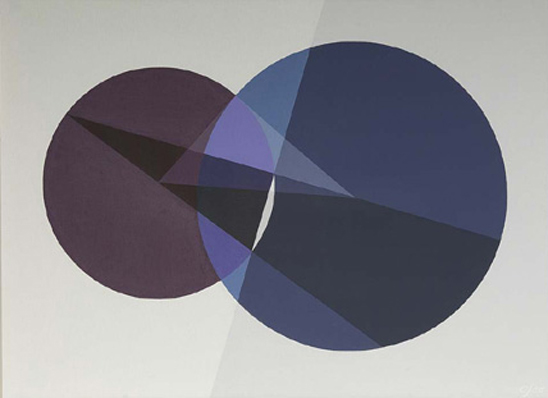
- In the late 1960s and early 1970s, the American cartoonist Crockett Johnson created a series of paintings on mathematical subjects. This oil painting, #74 in the series, dates from 1969 and is signed "CJ69." It is based on a theorem in plane geometry proved by the English-born mathematician Frank Morley (1860–1937). Morley emigrated to the United States and taught at Haverford College and Johns Hopkins University.
- The painting illustrates his best-known result. It shows lines that divide the three angles of the large triangle into three equal parts. Lines coming from different vertices of the triangle meet in points. The triangle formed by joining the intersections of the trisectors, which lie nearest to the three sides of the triangle, is shown in white in the painting. According to Morley's theorem, this is an equilateral triangle.
- Location
- Currently not on view
- Date made
- 1969
- painter
- Johnson, Crockett
- ID Number
- 1979.1093.48
- catalog number
- 1979.1093.48
- accession number
- 1979.1093
- Data Source
- National Museum of American History, Kenneth E. Behring Center

