Measuring & Mapping - Overview

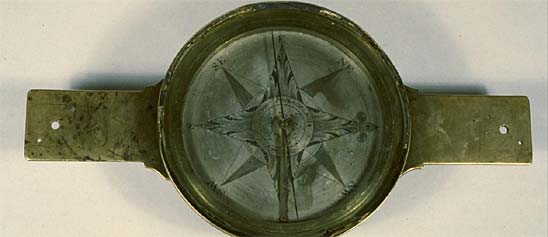
Where, how far, and how much? People have invented an astonishing array of devices to answer seemingly simple questions like these. Measuring and mapping objects in the Museum's collections include the instruments of the famous—Thomas Jefferson's thermometer and a pocket compass used by Meriwether Lewis and William Clark on their expedition across the American West. A timing device was part of the pioneering motion studies of Eadweard Muybridge in the late 1800s. Time measurement is represented in clocks from simple sundials to precise chronometers for mapping, surveying, and finding longitude. Everyday objects tell part of the story, too, from tape measures and electrical meters to more than 300 scales to measure food and drink. Maps of many kinds fill out the collections, from railroad surveys to star charts.
"Measuring & Mapping - Overview" showing 653 items.
Page 4 of 66
Standard Tungsten Lamp
- Description
- Irving Langmuir received a Ph.D. in physical chemistry in 1906 from the University of Göttingen. He studied under Walther Nernst, who had invented a new type of incandescent lamp only a few years before. In 1909 Langmuir accepted a position at the General Electric Research Laboratory in Schenectady, New York. Ironically, he soon invented a lamp that made Nernst's lamp (and others) obsolete.
- Langmuir experimented with the bendable tungsten wire developed by his colleague William Coolidge. He wanted to find a way to keep tungsten lamps from "blackening" or growing dim as the inside of the bulb became coated with tungsten evaporated from the filament. Though he did not solve this problem, he did create a coiled-tungsten filament mounted in a gas-filled lamp—a design still used today.
- Up to that time all the air and other gasses were removed from lamps so the filaments could operate in a vacuum. Langmuir found that by putting nitrogen into a lamp, he could slow the evaporation of tungsten from the filament. He then found that thin filaments radiated heat faster than thick filaments, but the same thin filament–wound into a coil–radiated heat as if it were a solid rod the diameter of the coil. By 1913 Langmuir had gas–filled lamps that gave 12 to 20 lumens per watt (lpw), while Coolidge's vacuum lamps gave about 10 lpw.
- During the 1910s GE began phasing-in Langmuir's third generation tungsten lamps, calling them "Mazda C" lamps. Although today's lamps are different in detail (for example, argon is used rather than nitrogen), the basic concept is still the same. The lamp seen here was sent to the National Bureau of Standards in the mid 1920s for use as a standard lamp.
- Lamp characteristics: Brass medium-screw base with skirt and glass insulator. Two tungsten filaments (both are C9 configuration, mounted in parallel) with 6 support hooks and a support attaching each lead to the stem. The stem assembly includes welded connectors, angled-dumet leads, and a mica heat-shield attached to the leads above the press. The shield clips are welded to the press. Lamp is filled with nitrogen gas. Tipless, G-shaped envelope with neck.
- Date made
- ca 1925
- date made
- ca. 1925
- ID Number
- 1992.0342.23
- accession number
- 1992.0342
- catalog number
- 1992.0342.23
- Data Source
- National Museum of American History, Kenneth E. Behring Center
Gurley Vara Chain
- Description
- This chain is marked "W. & L. E. GURLEY" and "20 VARA STEEL No. 12." It has 100 links made of No. 12 steel wire, brass handles and tallies, and measures 20 varas overall. The links and rings are brazed shut. Gurley began offering vara chains in 1874, noting that the Spanish or Mexican vara "is in very general use in Texas, Mexico, Cuba, and South America." The vara is roughly equivalent to 33 inches, but was never standardized as were the yard and the meter.
- Ref: W. & L. E. Gurley, Manual of the Principal Instrument Used in American Engineering and Surveying (Troy, N.Y., 1874), p. 44.
- maker
- W. & L. E. Gurley
- ID Number
- 1994.0280.01
- catalog number
- 1994.0280.01
- accession number
- 1994.0280
- Data Source
- National Museum of American History, Kenneth E. Behring Center
Odyssey 1 Dobsonian Reflecting Telescope
- Description
- This is a Dobsonian-type reflecting telescope. It was made commercially in the 1980s as part of the "Dobsonian revolution" in amateur astronomy.
- John Dobson began developing this form of telescope in 1956. At the time he was living in a monastery in San Francisco, working as a gardener. Although he had a degree in chemistry, Dobson had always been interested in spiritual issues. Seeking a way to directly experience a fundamental reality, he became obsessed with seeing the "deep sky"—the distant realm of nebula and galaxies.
- Unfortunately, to actually see these astronomical objects required large telescopes that were generally only available to astronomers and were too expensive for average people, and especially for Dobson, who had taken a vow of poverty.
- Undeterred, Dobson began teaching himself telescope making. In time he developed a new telescope design and a new approach to telescope making. Compared to the typical amateur telescope of the time, what came to be known as the "Dobsonian" telescopes were large, easy to use, inexpensive, and portable. They were also easy to make. The mirrors were ground from simple porthole glass. The mounts were made from common construction materials. Although comparatively crude, these strange new telescopes worked. Thrilled by his success, Dobson put them on wheels and pulled them around the streets of San Francisco, offering to show the wonders of the sky to anyone he met.
- Around 1967 Dobson helped found the Sidewalk Astronomers. They became famous for touring the United States, setting up their telescopes (affectionately known as "light buckets") and inviting passers-by to look through them. Telescope design continues to evolve and today the majority of amateur telescopes (like this one) are precise and commercially made. However, many active amateur astronomers credit an early encounter with a Dobsonian for starting their interest in astronomy and changing the way they view the sky.
- Location
- Currently not on view
- Date made
- 1988
- patent holder
- Dobson, John L.
- maker
- Coulter Optical Co.
- ID Number
- 1994.0399.01
- accession number
- 1994.0399
- catalog number
- 1994.0399.01
- Data Source
- National Museum of American History, Kenneth E. Behring Center
B. Rittenhouse Wye Level
- Description
- This wye level, one of the earliest made in America, is marked "Made by Benjn Rittenhouse." It was made around 1785, and owned by George Gilpin, the chief surveyor for the Potowmack Canal Navigation Company. Although this Canal Company had been organized in 1772, the project was shelved during the Revolution. It was resumed in 1785, and construction began the following year. Thomas Ellicott purchased the level at the sale of Gilpin's estate in Alexandria, Virginia, in 1813, and it remained in his family until its donation to the Smithsonian in 1997. The level vial of this instrument is mounted above the telescope. In the form that would become standard in the 19th century, the level hangs below the telescope.
- Ref: Silvio A. Bedini, "The Telescopic Level in Early America," Rittenhouse 11 (1997): 109-123.
- maker
- Rittenhouse, Benjamin
- ID Number
- 1997.0353.01
- accession number
- 1997.0353
- catalog number
- 1997.0353.01
- Data Source
- National Museum of American History, Kenneth E. Behring Center
Seiko Quartz Wristwatch
- Description
- The Seiko Quartz Astron 35 SQ was the first quartz wristwatch on the market. The first commercially available quartz watch went on sale in Tokyo on Christmas Day in 1969. With a limited production run of only about 100 pieces, these watches had analog dials and sold for 450,000 yen ($1250), roughly the same price as a Toyota Corolla. The watches were manufactured in Suwa City, Japan, by the firm Suwa Seikosha (now Seiko Epson) and were marketed by the parent company K. Hattori & Co., Ltd.
- The case and band on the Smithsonian example are a reproduction of those that originally came with Seiko’s 1969 wristwatch. Inside is an original module that contains a hybrid circuit (a combination of circuits on a single substrate, an intermediate step between discrete circuits and integrated circuits), a quartz oscillator with a frequency of 8,192 cycles per second and a miniature stepping motor for moving the hands. Seiko claimed the new watches were accurate to within plus or minus 5 seconds a month, a minute a year.
- At the time of the Astron’s introduction, Seiko produced more mechanical watches than any other firm in the world. But company officials had been experimenting with quartz timekeeping since the late 1950s. Beginning in 1959, a team of engineers, under Tsuneya Nakamura, started to develop a quartz wristwatch. Their first quartz timekeepers were battery-powered chronometers, one of which was used in the Olympic Games in Tokyo in 1964. By 1967, Seiko engineers had miniaturized the timekeeper to produce a wristwatch prototype. To develop manufacturing techniques required another two years.
- The Astron was the first public indicator that the wristwatch was about to be completely reinvented, with all-new electronic components. When battery-driven quartz wristwatches like the Astron first hit the market, it seemed unlikely that the new-fangled gadgets would sell. But electronic watches won over the buying public in a few short years.
- Reference:
- Stephens, Carlene and Maggie Dennis. “Engineering Time: Inventing the Electronic Wristwatch,” British Journal for the History of Science 33 (2000): pp. 477-497.
- date made
- 1969
- 1998
- manufacturer
- Seiko Corporation
- ID Number
- 1998.0248.01
- catalog number
- 1998.0248.01
- accession number
- 1998.0248
- Data Source
- National Museum of American History, Kenneth E. Behring Center
Railroad Watch
- Description
- This English watch was a part of a technical fix applied to U.S. railroads following accidents in the middle of the 19th century.
- Back then timetables governed train arrivals and departures, established train priorities, and ensured that trains did not collide on single-track lines. Clocks in railroad stations and watches held by conductors and engineers helped to enforce the timetables.
- But in the middle of the 19th century, timepieces in use on the railroads varied wildly in quality and availability to employees of the line. There was no single standard of quality for railroad timekeepers. After a horrific fatal accident on the Providence & Worcester Railroad in August 1853, caused in part by the inaccuracy of a conductor's watch, some railroads in New England responded to public criticism of their industry by tightening up running rules and ordering top-quality clocks and watches for their employees.
- This is one such high-quality railroad watch.
- An official representing the Vermont Central Railroad and three other New England lines, William Raymond Lee, ordered watches and clocks in late 1853 from William Bond & Sons, Boston, the American agent for Barraud & Lund of London. The English firm delivered the first of the timepieces in January 1855. The Vermont Central purchased fifteen watches for $150 each and one clock for $300.
- Barraud & Lund, founded in 1750 by Huguenot watchmaker Francis-Gabriel Barraud, had a long-standing reputation for high-quality timepieces, including marine chronometers, clocks and watches. By the middle of the nineteenth century, the firm had extensive foreign markets and added John Richard Lund, a chronometer maker, to their business.
- William Bond & Son, the firm named on the watch's dust cap, was one of the principal timepiece purveyors of nineteenth-century America. Intimately connected to navigation and commercial shipping, the firm rated and repaired marine chronometers for the busy port of Boston and supplied instruments of all sorts to agencies of the federal government-specifically, the coast survey, the topographical engineers, and the navy. The firm, whose original business provided time for navigating at sea, branched out with the railroad business to perform the same service on land.
- Location
- Currently not on view
- Date made
- 1853
- maker
- Barraud & Lund
- ID Number
- 1999.0278.01
- catalog number
- 1999.0278.01
- accession number
- 1999.0278
- Data Source
- National Museum of American History, Kenneth E. Behring Center
Hotel Kankakee ruler
- Description (Brief)
- An advertising novelty for the Hotel Kankakee of Kankakee, Ill. This six-inch ruler is made of celluloid and has a 1929 calendar printed on the reverse. The front has advertising copy stating "All Outside Rooms Fireproof" and "Wonderful Dining Room."
- Location
- Currently not on view
- date made
- 1929
- maker
- American Art Works, Inc.
- ID Number
- 2006.0098.1045
- accession number
- 2006.0098
- catalog number
- 2006.0098.1045
- Data Source
- National Museum of American History, Kenneth E. Behring Center
Goldstone Master Clock and Distribution Assembly
- Description
- This is timing equipment from NASA's Goldstone Deep Space Communications Complex in the Mojave Desert near Barstow, Calif. It was installed at Goldstone about 1984. Based on specifications from NASA's Goddard Space Flight Center, the assembly was designed and made by TRAK Microwave of Tampa, Florida, and used at Goldstone to provide time codes for the ground station and space navigation until 2006. While in service, the assembly timed an impressive list of missions, including the two Voyagers launched in 1977 and the highly publicized Mars missions in 1996, 2001, 2003 and 2005. The equipment could track about thirty missions simultaneously and served about one hundred users.
- The assembly contains three clocks—Clocks A, B and C (2008.0145.01, .02, and .03)—that work together as the master clock. Also known as a triple redundant clock, the three together "vote" on a single time of day, with agreement between two of the three determining the correct time. The master clock receives a reference frequency from a suite of atomic frequency standards (one primary and three backups). The master clock converts that frequency into time codes. Reference frequency signals and time codes are in turn distributed by the time insertion distribution system (2008.0145.04) to user locations in NASA's Deep Space Network for tracking spacecraft and radioastronomy experiments.
- Time and frequency are essential to the Deep Space Network, a group of three communications facilities placed approximately 120 degrees apart around the world at Goldstone, near Madrid, Spain and near Canberra, Australia. The network synchronizes the three stations plus the Jet Propulsion Laboratory in Pasadena, CA, to an accuracy of microseconds through comparisons with each other and with time from the Global Positioning System.
- date made
- ca 1984
- ID Number
- 2008.0145.01
- accession number
- 2008.0145
- catalog number
- 2008.0145.01
- Data Source
- National Museum of American History, Kenneth E. Behring Center
Goldstone Master Clock and Distribution Assembly
- Description
- This is timing equipment from NASA's Goldstone Deep Space Communications Complex in the Mojave Desert near Barstow, Calif. It was installed at Goldstone about 1984. Based on specifications from NASA's Goddard Space Flight Center, the assembly was designed and made by TRAK Microwave of Tampa, Florida, and used at Goldstone to provide time codes for the ground station and space navigation until 2006. While in service, the assembly timed an impressive list of missions, including the two Voyagers launched in 1977 and the highly publicized Mars missions in 1996, 2001, 2003 and 2005. The equipment could track about thirty missions simultaneously and served about one hundred users.
- The assembly contains three clocks—Clocks A, B and C (2008.0145.01, .02, and .03)—that work together as the master clock. Also known as a triple redundant clock, the three together "vote" on a single time of day, with agreement between two of the three determining the correct time. The master clock receives a reference frequency from a suite of atomic frequency standards (one primary and three backups). The master clock converts that frequency into time codes. Reference frequency signals and time codes are in turn distributed by the time insertion distribution system (2008.0145.04) to user locations in NASA's Deep Space Network for tracking spacecraft and radioastronomy experiments.
- Time and frequency are essential to the Deep Space Network, a group of three communications facilities placed approximately 120 degrees apart around the world at Goldstone, near Madrid, Spain and near Canberra, Australia. The network synchronizes the three stations plus the Jet Propulsion Laboratory in Pasadena, CA, to an accuracy of microseconds through comparisons with each other and with time from the Global Positioning System.
- date made
- ca 1984
- ID Number
- 2008.0145.02
- accession number
- 2008.0145
- catalog number
- 2008.0145.02
- Data Source
- National Museum of American History, Kenneth E. Behring Center
Goldstone Master Clock and Distribution Assembly
- Description
- This is timing equipment from NASA's Goldstone Deep Space Communications Complex in the Mojave Desert near Barstow, Calif. It was installed at Goldstone about 1984. Based on specifications from NASA's Goddard Space Flight Center, the assembly was designed and made by TRAK Microwave of Tampa, Florida, and used at Goldstone to provide time codes for the ground station and space navigation until 2006. While in service, the assembly timed an impressive list of missions, including the two Voyagers launched in 1977 and the highly publicized Mars missions in 1996, 2001, 2003 and 2005. The equipment could track about thirty missions simultaneously and served about one hundred users.
- The assembly contains three clocks—Clocks A, B and C (2008.0145.01, .02, and .03)—that work together as the master clock. Also known as a triple redundant clock, the three together "vote" on a single time of day, with agreement between two of the three determining the correct time. The master clock receives a reference frequency from a suite of atomic frequency standards (one primary and three backups). The master clock converts that frequency into time codes. Reference frequency signals and time codes are in turn distributed by the time insertion distribution system (2008.0145.04) to user locations in NASA's Deep Space Network for tracking spacecraft and radioastronomy experiments.
- Time and frequency are essential to the Deep Space Network, a group of three communications facilities placed approximately 120 degrees apart around the world at Goldstone, near Madrid, Spain and near Canberra, Australia. The network synchronizes the three stations plus the Jet Propulsion Laboratory in Pasadena, CA, to an accuracy of microseconds through comparisons with each other and with time from the Global Positioning System.
- date made
- ca 1984
- ID Number
- 2008.0145.03
- accession number
- 2008.0145
- catalog number
- 2008.0145.03
- Data Source
- National Museum of American History, Kenneth E. Behring Center
- Next Page

