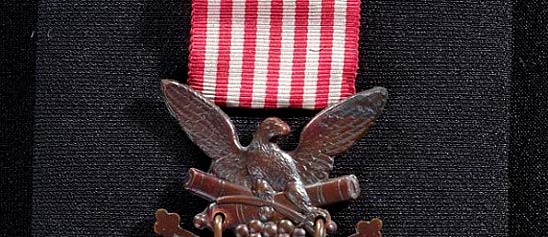
Military - Overview

The Museum's superb military collections document the history of the men and women of the armed forces of the United States. The collections include ordnance, firearms, and swords; uniforms and insignia; national and military flags and banners; and many other objects.
The strength of the collections lies in their enormous depth. Some 3,000 military small arms and 2,400 civilian firearms document the mechanical and technological history of the infantryman's weapons from the beginning of the gunpowder era to the present. Among the 4,000 swords and knives in the collection are many spectacular presentation pieces. The collections also include Civil War era telegraph equipment, home front artifacts from both world wars, early computers such as ENIAC, Whirlwind, and Sage, and materials carried at antiwar demonstrations.
"Military - Overview" showing 3 items.
Robert E. Lee's chair from Appomattox
- Description
- On April 9, 1865, General Ulysses S. Grant and General Robert E. Lee met in the home of Wilmer McLean at Appomattox Court House, Virginia, to negotiate the surrender of the Confederate Army of Northern Virginia to the United States Army. Sitting in the chair on the left, Lee discussed the fate of his troops. Grant then, leaning over an oval table, drafted and signed the final terms of surrender. While there were still Confederate troops in the field under other commanders, Lee's surrender effectively marked the end of the Civil War.
- Union officers, recognizing the significance of the event, individually took pieces of furniture as souvenirs. General E. W. Whitaker grabbed Lee's chair, General Henry Capehart claimed Grant's chair, and General Philip Sheridan took the table and presented it to the wife of Major General George Amstrong Custer. In three separate donations, by 1915, these items were reunited at the Smithsonian Institution.
- Date made
- before 1865
- associated date
- 1865-04-09
- user
- Lee, Robert Edward
- ID Number
- PL*015820
- catalog number
- 15820
- accession number
- 59140
- catalog number
- 15820
- Data Source
- National Museum of American History, Kenneth E. Behring Center
Ulysses S. Grant's chair from Appomattox
- Description
- On April 9, 1865, General Ulysses S. Grant and General Robert E. Lee met in the home of Wilmer McLean at Appomattox Court House, Virginia, to negotiate the surrender of the Confederate Army of Northern Virginia to the United States Army. Sitting in the chair on the right, Grant discussed the fate of Lee's troops. Then, leaning over the oval table, he drafted and signed the final terms of surrender. While there were still Confederate troops in the field under other commanders, Lee's surrender effectively marked the end of the Civil War.
- Union officers, recognizing the significance of the event, individually took pieces of furniture as souvenirs. General E. W. Whitaker grabbed Lee's chair, General Henry Capehart claimed Grant's chair, and General Philip Sheridan took the table and presented it to the wife of Major General George Amstrong Custer. In three separate donations, by 1915, these items were reunited at the Smithsonian Institution.
- Date made
- before 1865
- associated date
- 1865-04-09
- associated person
- Grant, Ulysses S. (Ulysses Simpson)
- ID Number
- PL*010517
- catalog number
- 010517
- accession number
- 45493
- Data Source
- National Museum of American History, Kenneth E. Behring Center
Plate 99. McLean's House, Appomattox Court-House, Where Grant and Lee signed the Capitulation
- Description
- Text and photograph from Gardner's Photographic Sketchbook of the War, Vol. II. Negative by Timothy H. O'Sullivan, text and positive by Alexander Gardner.
- On the evening of the 7th of April, 1865, General Grant first forwarded, under a flag of truce, a letter to Gen. Lee, demanding the surrender of the Army of Northern Virginia, in order to avoid the further effusion of blood. That army had re-crossed the Appomattox river at High Bridge and Farmville, closely pressed by Sheridan's cavalry and the Armies of the Potomac and James. On the 8th, some correspondence passed between the two Commanding Generals, the one army retreating towards Lynchburg, followed by the Second and Sixth Corps, whilst the cavalry and the Fifth and Twenty-Fourth Corps made forced marches in order to pass around and gain the front of the enemy. About noon on the 9th, the head of the Second Corps, when within three miles of Appomattox Court-House, came up with the rear guard of the enemy; and at the same time, Gen. Lee, in person, appeared with a flag of truce, and, by letter, asked for a suspension of hostilities, pending negotiations for a surrender. About four o'clock in the afternoon of that eventful Sunday, the glad tidings was announced throughout the Union Armies that the Army of Northern Virginia had surrendered. The excitement among our troops was unparalleled, officers and men uniting in the most extravagant demonstrations of joy. The photograph represents the house in which the terms of capitulation between Generals Grant and Lee were signed. The apple tree (about half a mile from the Court-House) under which they first met, has been entirely carried away in pieces, as mementoes, not even the roots remaining.
- It is a singular fact that the owner of this house, Mr. McLean, was living on the first Bull Run battle-field at the time of that engagement, and afterwards removed to this place for the purpose of being secure from the visitation of an army.
- Location
- Currently not on view
- date made
- 1865-04
- maker
- Gardner, Alexander
- ID Number
- 1986.0711.0283.49
- accession number
- 1986.0711
- catalog number
- 1986.0711.0283.49
- Data Source
- National Museum of American History, Kenneth E. Behring Center

