Music & Musical Instruments - Overview

The Museum's music collections contain more than 5,000 instruments of American and European heritage. These include a quartet of 18th-century Stradivari stringed instruments, Tito Puente's autographed timbales, and the Yellow Cloud guitar that belonged to Prince, to name only a few. Several of these rare instruments can be heard in performances of the Smithsonian Chamber Players and in other public programs. Music collections also include jukeboxes and synthesizers, square-dancing outfits and sheet music, archival materials, oral histories, and recordings of performances at the Museum. The vast Sam DeVincent Collection of Illustrated Sheet Music is a remarkable window into the American past in words, music, and visual imagery. The Duke Ellington and Ruth Ellington Boatwright collections contain handwritten music compositions, sound recordings, business records, and other materials documenting the career of this renowned musician.
"Music & Musical Instruments - Overview" showing 11 items.
Page 1 of 2
African-American Banjo
- Description (Brief)
- This banjo was made by an unknown maker in the United States around 1835-1865. It has undergone considerable scrutiny and analysis at the Smithsonian because of its attribution to American slave origins. So far, studies have been inconclusive. While the sun design carved on the body may have African origins, the polygonal shape, wood top (instead of a skin), and carved head pegbox lie outside the traditions of banjos brought to America by Africans. Nevertheless, the instrument was likely made by someone familiar with Black culture.
- Location
- Currently not on view
- date made
- 1835-1865
- ID Number
- 1990.0164.01
- accession number
- 1990.0164
- catalog number
- 1990.0164.01
- Data Source
- National Museum of American History, Kenneth E. Behring Center
Prince's Yellow Cloud Electric Guitar
- Description
- Custom-made in 1989 by the Minneapolis, Minn., firm of Knut-Koupee Enterprises, this Yellow-cloud electric guitar was designed and used by Prince. The musician's distinctive personal symbol adorns both the top and the side of the fingerboard. Custom work for famous instrumentalists and musicians provides an important marketing tool for small-scale guitar makers.
- Location
- Currently not on view
- date made
- 1989
- maker
- Haugen, Barry
- Rusan, David
- Knut-Koupee Enterprises, Inc.
- ID Number
- 1993.0435.01
- catalog number
- 1993.0435.01
- accession number
- 1993.0435
- Data Source
- National Museum of American History, Kenneth E. Behring Center
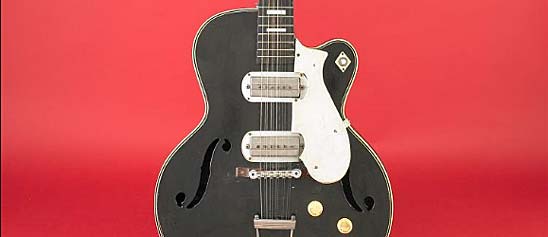
Jesse Fuller's Silvertone Electric-Acoustic Guitar
- Description (Brief)
- This electric-acoustic guitar was made for Sears in the late 1950s by companies like Danelectro and Harmony. Silvertone guitars were popular because of their solid construction and inexpensive pricing.
- This guitar was owned and played by Jesse Fuller (1896-1976), a one-man-band folk and blues singer from the San Francisco Bay area who accompanied his guitar-playing with singing, harmonica, percussion, and a foot-operated bass instrument called a fotdella. Fuller played guitar as a child but didn’t become a professional musician until the early 1950s. As a songwriter, Fuller is best known for his songs, “San Francisco Bay Blues” and “Beat It on Down the Line.”
- Location
- Currently not on view
- Date made
- late 1950s
- user
- Fuller, Jesse
- ID Number
- 1994.0053.01
- accession number
- 1994.0053
- catalog number
- 1994.0053.01
- Data Source
- National Museum of American History, Kenneth E. Behring Center
Boucher Five-String Fretless Banjo
- Description (Brief)
- This banjo was made by William Boucher, Jr. in Baltimore, Maryland in 1845. Boucher was a drum maker and musical instrument dealer. He became the first commercial maker of banjos, perhaps through his association with the celebrated minstrel banjoist Joel Walker Sweeney.
- Boucher's instruments were important in standardizing the form of the banjo in its transition from a home-made rural instrument to urban, commercial manufacture. The basic shape and string arrangement has changed little up to the present day. Boucher’s design copied important features of earlier home-made African American instruments: the skin head, short thumb string and fretless neck. He added a scrolled peghead similar to those used by guitar makers W. Stauffer and C.F. Martin, and replaced the traditional gourd body with a thin, bentwood rim construction with screw-tightening brackets similar to that used for drum heads. Boucher’s innovations were well-adapted to commercial mass-production and urban musical tastes, and played a large part in the subsequent worldwide enthusiasm for the banjo.
- These commercial “improvements’ were never adopted by many traditional rural musicians, who continued to make good sounding instruments that were entirely adequate for their musical needs from locally available materials, at little or no expense.
- Location
- Currently not on view
- date made
- 1845
- maker
- Boucher, Jr., William
- ID Number
- MI*094764
- catalog number
- 094764
- accession number
- 22989
- Data Source
- National Museum of American History, Kenneth E. Behring Center
Wurlitzer Electric Piano
- Description (Brief)
- This electric piano was made by the Wurlitzer Company, in Dekalb, Illinois, around 1972-1973. This model, 200A, continued in production into 1980. It was used by jazz musician and composer, Duke Ellington. Duke used this piano during many of his travels and would use it to compose and play music, sometimes in the middle of the night. This piano is serial #129394L, and has 2 control knobs: volume and vibrato, and a plastic case and 4 detachable chrome-plated tapered legs.
- Location
- Currently not on view
- Date made
- 1972-1973
- user
- Ellington, Duke
- maker
- Wurlitzer Company
- ID Number
- 1999.0148.01
- serial number
- 129394L
- model number
- 200A
- accession number
- 1999.0148
- catalog number
- 1999.0148.01
- Data Source
- National Museum of American History, Kenneth E. Behring Center
Gourd Folk Fiddle
- Description (Brief)
- This folk fiddle was made in St. Mary's County, Maryland in the 19th century by an unknown maker. This fiddle and its accompanying bow are probably from the black slave cultural tradition of the American plantation. The instrument is made with a skin top nailed to a gourd body, and was recovered from an outbuilding of a large estate in St. Mary’s County, Maryland. This folk fiddle is made of a table of hide fastened with fifty-five iron nails to the gourd body which has two “slit” soundholes, neck of walnut with pegbox and four ash pegs, and a hardwood fingerboard and bone nut. The bow made for the fiddle is modeled after classical bow design.
- Location
- Currently not on view
- Date made
- 19th century
- ID Number
- MI*75.44
- accession number
- 316462
- catalog number
- 75.44
- Data Source
- National Museum of American History, Kenneth E. Behring Center
“At an Ole Virginia Wedding” Sheet Music
- Description (Brief)
- This sheet music for the song "At an Ole Virginia Wedding" was written and composed by Maurice J. Steinberg. The music was originally published by T. B. Harms and Co. of New York, New York in 1900 and as a Musical Supplement to the “Philadelphia Press on Sunday, September 9, 1900. The cover portrays a Negro wedding ceremony. The colorful image depicts a bride and groom with stereotyped features. The background shows the guests dancing and talking while a band plays in the top right corner of the picture.
- Location
- Currently not on view
- Date made
- 1900
- distributor
- Philadelphia Press
- composer; lyricist
- Maurice J. Steinberg & Co.
- publisher
- T. B. Harms & Co.
- ID Number
- 1982.0440.21
- accession number
- 1982.0440
- catalog number
- 1982.0440.21
- Data Source
- National Museum of American History, Kenneth E. Behring Center
sound recording: Southern Exposure; Uncle Sam Says
- Description (Brief)
- Joshua White. side 1: SOUTHERN EXPOSURE; side 2: UNCLE SAM SAYS (Keynote K 514). from the album, "Southern Exposure - An Album of Jim Crow Blues" (Keynote K 107)
- 78 rpm
- Location
- Currently not on view
- recording artist
- White, Joshua
- maker
- Keynote Recordings
- ID Number
- 1996.0320.05324
- maker number
- K514
- K 107
- accession number
- 1996.0320
- Data Source
- National Museum of American History, Kenneth E. Behring Center
sound recording: Jim Crow Train; Bad Housing Blues
- Description (Brief)
- Joshua White. side 1: JIM CROWE TRAIN; side 2: BAD HOUSING BLUES (Keynote K 515). from the album, "Southern Exposure - An Album of Jim Crow Blues" (Keynote K 107)
- 78 rpm
- Location
- Currently not on view
- recording artist
- White, Joshua
- maker
- Keynote Recordings
- ID Number
- 1996.0320.05325
- maker number
- K 515
- K 107
- accession number
- 1996.0320
- Data Source
- National Museum of American History, Kenneth E. Behring Center
sound recording: Hard Times Blues; Defense Factory Blues
- Description (Brief)
- Joshua White. side 1: HARD TIME BLUES; side 2: DEFENSE FACTORY BLUES (Keynote K 516). from the album, "Southern Exposure - An Album of Jim Crow Blues" (Keynote K 107)
- 78 rpm
- Location
- Currently not on view
- recording artist
- White, Joshua
- maker
- Keynote Recordings
- ID Number
- 1996.0320.05326
- maker number
- K 516
- K 107
- accession number
- 1996.0320
- Data Source
- National Museum of American History, Kenneth E. Behring Center