Music & Musical Instruments - Overview

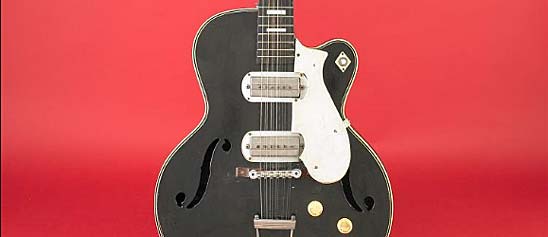
The Museum's music collections contain more than 5,000 instruments of American and European heritage. These include a quartet of 18th-century Stradivari stringed instruments, Tito Puente's autographed timbales, and the Yellow Cloud guitar that belonged to Prince, to name only a few. Several of these rare instruments can be heard in performances of the Smithsonian Chamber Players and in other public programs. Music collections also include jukeboxes and synthesizers, square-dancing outfits and sheet music, archival materials, oral histories, and recordings of performances at the Museum. The vast Sam DeVincent Collection of Illustrated Sheet Music is a remarkable window into the American past in words, music, and visual imagery. The Duke Ellington and Ruth Ellington Boatwright collections contain handwritten music compositions, sound recordings, business records, and other materials documenting the career of this renowned musician.
"Music & Musical Instruments - Overview" showing 53 items.
Page 1 of 6
Irving Ashby's Stromberg Guitar
- Description (Brief)
- This guitar was made by Charles A. Stromberg and Son of Boston, Massachusetts around 1939-1941. Responding to requests from jazz guitarist for an instrument that could cut through and be heard over the horn section of jazz bands, Elmer Stromberg developed his giant, 19-inch wide Master 400 model. It is one of the loudest acoustic guitars ever made. Elmer Stromberg made about 600 guitars with his father, Charles, a Swedish immigrant.
- Charles and Elmer Stromberg’s shop was a popular hang-out for local guitarists who would break in new instruments before they were sold to customers. One such local was Irving Ashby, a Boston native who went on to play with the Lionel Hampton Orchestra and the Nat King Cole Trio. This six course (6x1) guitar, Master 400 model, and serial #507, was custom made for American jazz guitarist, Irving Ashby (1920-1987).
- Location
- Currently not on view
- date made
- 1939-1941
- user
- Ashby, Irving
- maker
- Charles A. Stromberg and Son
- ID Number
- 1988.0421.01
- accession number
- 1988.0421
- catalog number
- 1988.0421.01
- Data Source
- National Museum of American History, Kenneth E. Behring Center
Parker Fly Electric Guitar
- Description (Brief)
- This electric guitar was made by Parker Guitars of Willmington, Massachusetts in 1997. The company began in the early 1990s by luthier, Ken Parker. Parker Fly guitars are unique in their appearance and incorporate a radical new approach to the construction of electric guitars. Ken Parker was co-patentee with Lawrence Fishman on a number of patents for this new style of guitar. In 2003 the company was sold to U.S. Music Corporation in Illinois. This electric guitar is a Fly Concert Model, serial #028017BMH, with four control knobs: master volume, magnetic volume, magnetic tone, and piezo volume and tone, and two toggle switches: magnetic pickup selector and piezo/magnetic pickup selector.
- Location
- Currently not on view
- Date made
- 1997
- maker
- Parker Guitars
- ID Number
- 1997.0299.01
- accession number
- 1997.0299
- catalog number
- 1997.0299.01
- Data Source
- National Museum of American History, Kenneth E. Behring Center
Chickering & Sons Grand Piano
- Description (Brief)
- This grand piano was made by Chickering and Sons in Boston, Massachusetts in 1865. This piano is identical to the one that Chickering won a gold medal with at the Paris Exposition in 1867. The piano is serial number 27733 and has a compass of AAA-c5, Edwin Brown patented action, copper-wound and plain steel strings, 1, 2, or 3 strings per note, layers of felt hammers, 2 pedals: una corda and damper lifter, a one-piece cast-iron frame, straight-strung, and a rosewood veneer case.
- Location
- Currently not on view
- date made
- 1865
- maker
- Chickering, Jonas
- ID Number
- 1981.0625.01
- accession number
- 1981.0625
- serial number
- 27733
- Data Source
- National Museum of American History, Kenneth E. Behring Center
Babcock Square Piano
- Description (Brief)
- This square piano was made by Alpheus Babcock in Boston, Massachusetts in the late 1820s. Babcock’s invention of a one-piece iron frame allowed piano makers to use higher-quality string, ultimately of steel, which provided the basis for greater depth of sonority and more volume, and the metal, being unaffected by changes in humidity, helped greater stability of tuning. This piano bears a plaque that reads “For R. Mackay, Boston.“ The Mackay family bankrolled Babcock, and their names are often found on his pianos. This piano is serial number 278, and has a compass of FF-c4, English double action, leather, basswood core hammers, double-strings throughout, 2 pedals: damper and harmonic swell, and a mahogany veneer over pine case with rosewood cross banding.
- Location
- Currently not on view
- date made
- 1825-1829
- maker
- Babcock, Alpheus
- ID Number
- 1982.0434.01
- catalog number
- 1982.0434.01
- accession number
- 1982.0434
- Data Source
- National Museum of American History, Kenneth E. Behring Center
"The Newport" Sheet Music
- Description (Brief)
- This sheet music for the song "The Newport" was arranged by Clifford Hale and published by P.R. McCargo of Boston, Massachusetts in 1889. The cover identifies the song as a “York Dance,” and the cover has a variety of geometric and floral designs.
- Location
- Currently not on view
- Date made
- 1889
- composer
- Hale, Clifford
- ID Number
- 1982.0439.38
- accession number
- 1982.0439
- catalog number
- 1982.0439.38
- Data Source
- National Museum of American History, Kenneth E. Behring Center
Chickering & Sons Grand Piano
- Description (Brief)
- This piano was made by Chickering & Sons in Boston, Massachusetts in 1857. Chickering called this type of piano a “parlor grand,“ but today it has come to be known as a “cocked-hat grand” because its shape from above is like that of a cocked hat. The piano is serial number 17390 and has a compass of CCC-c5, Edwin Brown, leather and felt hammers, wound and plain steel strings with 1 or 2 strings per note, 2 pedals: una corda and damper lifter, an iron frame, straight-strung, and a rosewood veneer case.
- Location
- Currently not on view
- date made
- 1857
- maker
- Chickering & Sons
- ID Number
- 1983.0377.01
- accession number
- 1983.0377
- catalog number
- 1983.0377.01
- Data Source
- National Museum of American History, Kenneth E. Behring Center
Vega Tu-ba-phone Banjo
- Description (Brief)
- This Tu-ba-phone model banjo was made by the Vega Company in Boston, Massachusetts around 1922. It has 28 brackets, a carved mahogany neck with an ebony fingerboard with inlaid pearl position marks, and a patented brass top hoop and bracket band over a 7 lap sectional maple hoop. The banjo and is stamped with the serial number 50232.
- The Vega Company purchased the A. C. Fairbanks Company in 1904 and produced banjos of high quality largely based on earlier designs of Fairbanks. This Tu-ba-phone model incorporated a heavy “tone ring” originally patented by Fairbanks in 1890, a feature still favored by modern banjo players for the quality of tone it produced.
- Location
- Currently not on view
- Date made
- 1909-1925
- date made
- ca 1922
- maker
- Vega Company
- ID Number
- 1987.0055.01
- catalog number
- 1987.0055.01
- accession number
- 1987.0055
- Data Source
- National Museum of American History, Kenneth E. Behring Center
Vega Tenor Banjo
- Description (Brief)
- This "Soloist" Vegaphone tenor banjo was made by the Vega Company in Boston, Massachusetts around 1929. It has 28 brackets, a maple neck with an ebony fingerboard with pearl position marks, patented brass top hoop and bracket band over a 7 lap sectional maple hoop, peghead with mother-of-pearl inlay, and a resonator made of five-ply figured maple. It is stamped with serial number 87500. In a 1928 Vega catalog, the "Soloist" banjo sold for $200 and was described as “…the ideal instrument for the player who desires a combination of superior tone and a flashing golden appearance.”
- Location
- Currently not on view
- Date made
- 1909-1925
- date made
- ca 1929
- maker
- Vega Company
- ID Number
- 1987.0055.02
- catalog number
- 1987.0055.02
- accession number
- 1987.0055
- Data Source
- National Museum of American History, Kenneth E. Behring Center
Vega-Vox IV Tenor Banjo
- Description (Brief)
- This four-string tenor banjo was made by the Vega Instrument Company Inc. of Boston, Massachusetts around 1965-1966. It is a "Vega-Vox IV" model, serial number A-125768, with a carved neck and an elaborate resonator. This banjo is listed in the 1964 Vega banjo flyer as selling for $930.00 plus $75.00 extra for the carved neck. In the late 1950s-early 1960s when a “folk-revival” boom hit in the United States, Vega was one of the few companies still producing banjos.
- Location
- Currently not on view
- date made
- 1965-1966
- maker
- Vega Instrument Co., Inc.
- ID Number
- 1998.0074.01
- catalog number
- 1998.0074.01
- accession number
- 1998.0074
- serial number
- A-125768
- Data Source
- National Museum of American History, Kenneth E. Behring Center
Fairbanks Five-String Banjo
- Description (Brief)
- This banjo was made by The A.C. Fairbanks Company of Boston, Massachusetts in 1899. It is a "Regent" model and stamped with serial number 18151. It has 28 brackets, neck and fingerboard with mother-of-pearl inlay, and a metal-covered wood hoop.
- Albert Conant Fairbanks began making banjos in 1868 with William A. Cole, a well-known Boston banjo player and teacher. Around 1888, the A.C. Fairbanks Co., Fairbanks was joined by David L. Day. Six years later, Fairbanks sold his interest in the company to businessmen Cummings & Dodge. In 1904, the Vega Co. acquired the business and continued to produce popular banjos made by Fairbanks.
- Location
- Currently not on view
- date made
- 1899
- maker
- A. C. Fairbanks Co.
- ID Number
- 1999.0296.01
- serial number
- 18151
- accession number
- 1999.0296
- catalog number
- 1999.0296.01
- Data Source
- National Museum of American History, Kenneth E. Behring Center
- Next Page

