National Quilt Collection - Videos

The National Quilt Collection, part of the Division of Home and Community Life's Textile Collection at the National Museum of American History, had its beginnings in the 1890s. Three quilts were included in a larger collection of 18th- and 19th- century household and costume items from one Stonington, Connecticut family. From this early beginning, the Collection has grown to more than 400 quilts and quilt-related items, mainly of American origin. Most of the contributions have come to the Museum as gifts, many from the quilt-makers' families. The quilts are part of a lasting material record of the American experience, and are preserved in perpetuity for all Americans. As few of the quilts are on exhibition at any given time, this film provides an overview, in quilt storage, of the behind-the-scenes activities of the staff and volunteers as they work with this rich and interesting collection.
Quilts were made primarily by women, and have played a large part in revealing evidence of the circumstances of their lives: economic levels, the goods available to them and their increasing consumerism, their thrift and extravagance, the opportunity for self-expression in an acceptable activity, their schooling and family education and instruction, their group activities, personal identity and reward, and skills.
Some of the quilts reflect very personal interests and concerns; others express political and societal concerns such as patriotism, anti-slavery sentiments, war and peace. Many quilts in the collection have inscriptions that leave us a textile record expressing the interests and feelings of the makers. Others provided the makers an opportunity for artistic expression in a practical endeavor.
Altogether, the collection shows the progression and notable phases in American quilt-making; provides a history of materials available to the quilt makers and of the techniques practiced; illustrates many social, cultural, technological, and economic influences affecting quilts made and used in America; and contributes to the illumination of American life, family, community, and country.
The Division of Home and Community Life continues its long term mission to maintain and develop research-based collections that document and preserve American stories through family, community, biographical/individual oral histories and other materials. The quilt collection, for the most part, represents the middle class and affluent of the eastern half of the country, rather than a potpourri of the widely diverse population of the nation. We should like to encourage viewers to come forward with quilts and other needlework, to donate or to be recorded, with histories that contribute to our awareness of the rich diversity of the people who came to live here, the traditions they brought and carry on, and the ways in which they adopted the endeavors already here. Please contact us at bowmand@si.edu.
Videos
This virtual tour was made possible by a grant from Patty Stonesifer and Michael Kinsley through The Seattle Foundation.
The gift was made in honor of Mrs. Frances Quigley.
Smithsonian National Quilt Collection: An Overview
Smithsonian National Quilt Collection: Quilt Scene Investigation
In the Textile Analysis Lab, Kathy Dirks demonstrates how technical analyses of quilts with scientific equipment is used for identification and verification
Smithsonian National Quilt Collection: Quilt Care
Kathy Dirks shows the quilt storage room, and the cabinets and materials used in housing the collection.
Smithsonian National Quilt Collection: Machine Quilting
Barbara Janssen shows the patent model of a Grover & Baker sewing machine and explains how the stitch it produced helped to determine the probable date of a quilt in the collection.
Smithsonian National Quilt Collection: Civil War Sunday School Quilt
Virginia Eisemon discusses the history of a quilt made by a Maine Sunday school class for the benefit of hospitalized Union soldiers
Smithsonian National Quilt Collection: Lydia Finnell's Star Quilt
Sheryl DeJong identifies the techniques and stitches in a late 19th-century crazypatch quilt and discusses the availability of materials, patterns, and instructions at the time.
Links
NMAH Collections Site
Quilts, Counterpanes and Throws: A Selection from the National Collection
NMAH quilts in the general Smithsonian Collections
"National Quilt Collection - Videos" showing 11 items.
Page 1 of 2
1840 Eliza Hussey's Masonic Symbols Quilt`
- Description
- Eliza Rosecrans Hussey personalized her pieced wool-and silk-star quilt with symbols of the Masonic Society. The embroidered motifs are interspersed between twenty-five blocks pieced in a variation of the “Feathered Star” pattern. Another silk quilt in the Collection was also made by Eliza, and was embroidered with symbols and inscriptions of the Odd Fellows. Edward Simmons Hussey, her husband, was an active member of both the Masons and the Odd Fellows.
- Eliza, born about 1817 in Pennsylvania, went with her family to Indiana as a young child. In the early 1830s she married Edward Simmons Hussey in Carlisle, Indiana. They lived in various Indiana towns while Edward worked as a merchant, hotel manager, book keeper, and express agent.
- By 1860 they had settled in Brazil, Indiana, where Eliza worked as a milliner. There they raised their family of ten children. Eliza, after some years as an invalid, died in 1880. Her carefully designed and crafted quilts are a reminder of the importance of benevolent societies such as the Masons and the Odd Fellows in the developing towns and cities in the Midwest in the first half of the nineteenth century.
- Location
- Currently not on view
- Date made
- 1840
- quilter
- Hussey, Eliza Rosenkrantz
- ID Number
- 1981.0680.01
- catalog number
- 1981.0680.01
- accession number
- 1981.0680
- Data Source
- National Museum of American History, Kenneth E. Behring Center
1841 Ann Bender Snyder's Child's Quilt
- Description
- This white-work child's quilt belonged to Ann Bender Snyder in the 1840s, whether it was intended for her own child is not known. Forty years later Ann Bender Snyder gave the quilt to her god daughter, Nina Knode, as a baptismal gift when she was six months old. Nina Knode Heft always felt that it was a "museum piece" and that "after she was gone nobody would be interested in taking care of [it] in the same manner as she had." William Heft, Nina Knode's husband, followed his wife's wishes and donated it in her name to the Museum in 1940.
- The all white cotton quilt has a center medallion consisting of a basket of fruit above the quilted initials "A B S" enclosed in a feathered vine. This in turn is surrounded by an undulating vine bearing grapes, flowers, and pineapples. Stems and straight lines are stuffed with cotton roving. The border has a zigzag row of pointed oval leaves. Three sides of the quilt are edged with a 3-inch netted fringe.
- Ann Bender was born in about 1830, and married Oliver H. Snyder on 15 September 1847. In 1848 they had a daughter, Alice, who died at age five in 1853. Both Ann and Oliver Snyder lived in Funkstown, Maryland. Both died in 1887 and are buried in the Funkstown Public Cemetery.
- Location
- Currently not on view
- Date made
- 1841
- quilter
- Snyder, Ann Bender
- ID Number
- TE*T08434
- accession number
- 157749
- catalog number
- T08434
- Data Source
- National Museum of American History, Kenneth E. Behring Center
1842 Nancy Ward Butler's "Tombstone" Quilt
- Description
- Nancy Ward Butler made this quilt to commemorate the death of her granddaughter in 1842. Named for her grandmother, Nancy Adelaide Butler was born May 22 1840. She was the daughter of Calvin Butler (1818-1857), the quilt maker's son, and Mary A. Storey (1822-1909) whom he married in 1839. Nancy A. Butler died in February 1842 in Jamestown, N.Y. of scarlatina or scarlet fever, a serious and often fatal childhood disease at the time. In the nineteenth century, expressions of mourning were often part of the designs found on needlework and may have provided a way of working through grief as well as a memorial to a loved one.
- "NANCY A. BUTLER. DIED. FEB. 3 * 1842 * AGED 20 mo" is appliquéd on this quilt with roller and discharge printed blue and white cotton. The two sawtooth borders are pieced. The ground and lining are white plain woven cotton and the filling is cotton. The center section is quilted in parallel diagonal lines ½ to ¾ inches apart, in the border is a flowering vine; both quilted 6 stitches to the inch. A similar quilt in the McClurg Museum Chautauqua County Historical Society was possibly also made by Nancy. It memorializes her youngest son, James Butler who died of typhus at the age of 20 in 1844 and a granddaughter, Cynthia Smith Sage, who died in 1845 of consumption at the age of 23. Both are buried in the Laona Cemetery.
- Nancy Ward was born in 1779, daughter of Josiah Ward (1747/48-1825). Nancy Ward married James Butler (1780-1853) in 1802 in Buckland, Massachusetts. They settled in Chautauqua County, New York and raised their family, nine children, near Laona, New York. In 1855 Nancy Ward Butler was living in Jamestown, New York with her daughter Nancy Turner (1803-1889). They were both widowed. Nancy died in 1863.
- Nancy A. Butler Werdell, the donor, writes; "I am the namesake of the child, 'Nancy A. Butler,' memorialized on the quilt made by my ancestor [great-great grandmother], Nancy Ward Butler."
- She also commented about the quilt in Modern Maturity magazine in 1990; "Nancy was my great aunt! I inherited [the] quilt a number of years ago and donated it to the Smithsonian [1976]. I am so pleased that I have added to the folk history of our country in a small way. A quilt (or any prized treasure) preserved in the bottom of a trunk is a waste. Let's open our trunks and share our treasures." With the quilt, is a carefully printed, undated award; "Second Prize for the most Beautiful Quilt."
- Location
- Currently not on view
- Date made
- 1842
- quilter
- Butler, Nancy Ward
- ID Number
- TE*T18333
- catalog number
- T18333
- accession number
- 1977.0125
- Data Source
- National Museum of American History, Kenneth E. Behring Center
1843 Hannah Nicholson's Album Quilt
- Description
- Members of the Society of Friends, or Quakers, presented Hannah C. Nicholson with this album quilt made in 1843. She was 19 years old at the time and would shortly marry Howell Grave in 1845. A descendent wrote at the time of donation: “The quilt has been carefully tended since that time and regarded as an heirloom by our family.”
- In the mid-nineteenth century, album quilts with inscriptions and signatures were often made to celebrate an important event, and provide a textile record of friends and family. The forty-one appliquéd blocks and one inked block on this quilt are inscribed with names, dates, and places. Names of Hannah’s paternal relatives, Nicholson, Miller, Biddle, and Parrish, predominate.
- The quilt’s inscriptions indicate that some blocks were contributed by women in the name of relatives or young children, e.g. “for her brother” or “for her daughter.” When the block was for a son or daughter, the age was also added. The dates are given in the style of month, date and year with many of them just “8 Mo 1843.” Most of the places inked on the blocks are from the Philadelphia area, with a few from New Jersey (Woodbury, Bordentown, Pleasant Hill, and Salem). Although Hannah was born and lived in Indiana, her father was from New Jersey.
- The quilt is composed of forty-nine pieced and appliquéd blocks. The blocks are made with glazed, unglazed, and roller-printed cottons. These were joined by a 2 ½-inch glazed printed-stripe sashing. The same printed cotton is used for the border, providing a cohesive grid-like framework for the blocks. The quilting pattern is an overall diagonal grid, quilted 8 or 9 stitches per inch.
- Hannah C. Nicholson was born in Indiana on November 19, 1824, to John and Esther Nicholson. On August 14, 1845 Hannah married Howell Grave (1818-1894) in Wayne County, Indiana. Howell’s ancestors were among the earliest settlers of Indiana. His parents and grandparents arrived in the same year Indiana achieved statehood, 1816, and he was born there in 1818.
- Howell and Hannah farmed in Wayne County and raised four children, three girls (Esther, Emma, and Josephine) and a son (Vernon). In the early 1860s they moved to Richmond, Indiana, where for twenty years Howell was one of the principal iron merchants in the city. By the mid-1880s he was in the insurance and real estate businesses. Two of their daughters are listed as teachers on the 1870 census, while Vernon continued to farm. After Hannah was widowed in 1894, she lived with her daughter and son-in-law in Wayne, Indiana. She died there on February 13, 1912, and is buried in the Earlham Cemetery Richmond, Indiana.
- Location
- Currently not on view
- date made
- 1843
- maker
- unknown
- ID Number
- 1986.0657.01
- catalog number
- 1986.0657.01
- accession number
- 1986.0657
- Data Source
- National Museum of American History, Kenneth E. Behring Center
1845 Mary Jane Moran's Bride's Quilt
- Description
- This silk quilt, delicately appliquéd and embroidered with baskets and sprays of fruit and flowers, was made by Mary Jane Green Moran when she was a young bride in Baltimore, Maryland. The blocks are set diagonally and separated by a white silk sashing appliquéd and embroidered with bud-and-leaf vines, echoed by the undulating leafy vine in the border. The silk top is closely quilted, 12 to 15 stitches per inch, to a muslin backing. It was said that 1,001 skeins of silk thread were used in the quilting. A woven and knotted golden-colored silk fringe is stitched to three sides of this example of mid-nineteenth- century needlework.
- At the time of Mary Jane Green’s marriage in 1846 to Dr. Jonathan J. Moran, he was a resident physician at Washington University College Hospital in Baltimore. It was in that capacity that he attended the dying Edgar Allan Poe in October 1849. Dr. Moran in later years wrote several versions of those last hours that he spent with Edgar Allan Poe, and lectured on the topic as well. From the accounts, it appears that Mary Moran also nursed the dying Poe, reading to him as well as preparing his shroud.
- After the closing of the hospital in 1851, the Morans moved to Falls Church, Virginia, where they were both active in the community and the Dulin Methodist Episcopal Church. Dr. Jonathan Moran became the first mayor of Falls Church in 1875 and served until 1877. He died in 1888, and Mary Jane died the following year.
- Location
- Currently not on view
- Date made
- 1845
- quilter
- Moran, Mary Jane Green
- ID Number
- TE*T07140
- accession number
- 123393
- catalog number
- T07140
- Data Source
- National Museum of American History, Kenneth E. Behring Center
1846 Merinda Shedd Wright's "Nine-patch" Album Quilt
- Description
- In 1846 nearly 100 friends and family members contributed signed blocks for an album quilt for Merinda Shedd Wright of Washington, N. H. Possibly made before she moved West, the inscriptions include the towns of Washington, Peterborough, Stoddard, and Goshen in New Hampshire, as well as Lowell and Cambridge Port in Massachusetts.
- The signers were the wives or daughters of farmers, marble cutters, mechanics, laborers, shoemakers, doctors, clergy, merchants, and others who populated the New England area in the mid-19th century. A few worked in the Lowell, Mass., mills. They ranged in age from two to the eighties, often mother and daughter combinations.
- Ninety-six pieced 8-inch “Nine-patch” signed blocks are set diagonally with 32 half blocks around the entire border. All are signed, and except for one stamped inscription, all are inscribed in ink. Three blocks are dated 1846. The blocks are separated and bordered with printed cotton sashing. The lower corners of the quilt are cut away to accommodate bedposts.
- Merinda Shedd, born May 1811, was the daughter of John Shedd (about 1784-1828) and Lydia Farnsworth (1785-1860). Merinda married Zophar Wright (1805-1880). The couple had seven children. It seems Merinda went West, but no further information about her was discovered. Zophar was listed as living in New Hampshire on the 1850 census (pauper) and 1860 census (basket maker). He remarried in 1877 and again in 1879.
- Sarah Shedd (1813-1867), sister of Merinda Shedd, penned the following on the quilt: “Oh! A Sister’s heart is deep - And her spirit strong to keep - Each light-link of early hours.” The lines are from a poem, “The Shepherd-poet of the Alps,” by English poet, Felicia Hemans (1793-1835). Sarah was 15 when, after her father died, she found work in the textile mills of Maine and Massachusetts to help support her mother and educate her brother.
- In addition to working in the mills, she became a poet and educator. She wrote for the Lowell Offering , and a book of her poetry, Poems of Sarah Shedd, Founder of the Shedd Free Library was published in 1883.
- Educated, independent, and able to pursue her own interests after her mother’s death, she aspired to found a public library for her hometown of Washington, N. H. Her entire estate, $2,500 (over $400,000 today), was left to the Town to establish a library which opened in 1869 as the Shedd Free Library and contained many of her own books. In 1881 a permanent building was dedicated that is still a functioning library, having grown from the original 292 books to over 9000.
- Her sister's quilt descended in the Nathan Reed Wright family, but they were not related to Zophar and Merinda Wright. Jane Wright, adopted daughter of Nathan, did sign the quilt, apparently as a friend of Merinda.
- Location
- Currently not on view
- date made
- 1846
- maker
- unknown
- ID Number
- TE*T15195
- catalog number
- T15195
- accession number
- 290274
- Data Source
- National Museum of American History, Kenneth E. Behring Center
1846 Mary C. Nelson's "Eagle" Quilt
- Description
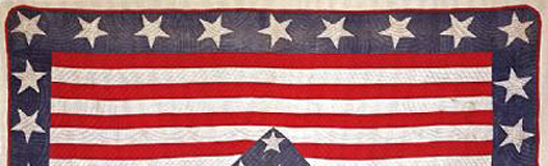
- Mary C. Nelson of Saratoga County, New York, appliquéd her patriotic quilt with an American eagle and 28 stars representing the number of states in 1846. Texas had become a state in December 1845. The eagle motif has been symbolic of the United States since 1782, when an image of the bird was adopted for official purposes.
- The appliquéd stars and eagle are made of discharge- and roller-printed cottons. The blue, brown, and white printed cotton used for the eagle has an effect of feathers. The 8-inch border is composed of six stripes, two each of a red ground print, a blue-and-white, and a plain white cotton contributing to the patriotic theme. Both the eagle and stars are outlined with a row of quilting very close to the appliquéd edge. Shell-pattern quilting enhances the eagle. The ground is quilted in a diagonal grid pattern of 8 stitches per inch. Mary’s name is cross-stitched in red below the eagle “MARY C. NELSON 22 1846.” The “22” possibly refers to her age.
- Mary Caroline Nelson was born March 22, 1824, in Saratoga Springs, Dutchess County, New York. She was the youngest of six children. Her father, Gilbert Nelson, had served in the War of 1812. On June 9, 1847 Mary married Platt Sutherland Pine (1816-1884) and moved to Sandy Plains, N.Y. They had five children. According to the 1884 Beers’ History of Greene County, in 1853 Platt S. Pine purchased the homestead property of his father and made many improvements. He was among the most prosperous and successful farmers in the area. Later in 1861 he built a boarding house in South Cairo, N.Y., near the railroad station, with magnificent views of the mountains and surrounding country. Mary died in January 1894 and is buried in the Catskill Rural Cemetery.
- Annie Pine, Mary’s granddaughter, visited the Smithsonian in 1937, and afterward wrote: “I . . . enjoyed viewing the quilts and saw you had none like this one and was told by the lady I could send it [Mary’s “Eagle” Quilt] there and it would be put with the others.” The quilt was donated in 1937 and has been featured in several exhibits.
- In the 1960s, over 100 years after it was made, Mary’s “Eagle” Quilt was faithfully reproduced by a quilting cooperative under the direction of Nancy Cole of Barwick, Kentucky. A VISTA (Volunteers in Service to America) project, the Grass Roots Citizens Committee, enabled the quilt makers of Breathitt County to obtain wholesale or donated fabrics, expand their market, and increase their earnings.
- date made
- 1846
- maker
- Nelson, Mary C.
- ID Number
- TE*T07957
- accession number
- 143844
- catalog number
- T07957
- Data Source
- National Museum of American History, Kenneth E. Behring Center
1847 Rev. Nadal's "Baltimore Album" Quilt
- Description
- “I have in my possession a quilt that was presented to my great-grandfather, Bernard Nadal, by the female members of his congregation when he was a minister . . . . It seems to me that it should be in a museum as the workmanship is exquisite . . . .” wrote Miss Constance Dawson in 1983 when the quilt top was donated to the Smithsonian.
- The Ladies of the Columbia Street Methodist Church congregation presented this “Baltimore Album” quilt top to Rev. Bernard H. Nadal in 1847. He had been a pastor at the church in Baltimore between 1845 and 1846 and left to attend Dickinson College in Carlisle, Pennsylvania, from which he graduated in 1848.
- “Album” or “friendship” quilts were popular in the mid-nineteenth century. The complex appliquéd blocks, typical of the Baltimore style, as well as signatures, poems, and drawings that grace this quilt top express the high regard the women must have had for Reverend Nadal.
- Variations of baskets, wreaths, vases, and floral designs are appliquéd on 17-inch blocks. An appliquéd flowering vine on the 9-inch border frames the twenty-five blocks on this quilt top which has neither filling nor lining. All of the blocks have embroidered or inked details and a name with often an additional poem and drawing. Almost all of the drawings, seemingly done by the same hand, are of a bird, generally a dove, with a ribbon or book sometimes on a monument or urn. These are motifs frequently found on “album” or “friendship” quilts in the mid-nineteenth century. A red Bible dated “1847” in the quilt’s center is inscribed: “To Rev. Bernard H. Nadal. Baltimore.” An inked drawing of a dove with a ribbon containing the name “Susan M. Shillingburg” is above the Bible and the inscription:
- “Accept my gift affection brings
- Though poor the offering be
- It flows from Friendship purest spring
- A tribute let it be.”
- Probably presented as a farewell gift, the inscriptions on this quilt top express friendship, good fortune in the future, and the wish to “forget me not.”
- Bernard H. Nadal was born in Talbot County, Maryland, in 1812. His father, from Bayonne, France, was said to have freed all his slaves and possibly influenced Bernard, who later had a reputation as a strong antislavery advocate and was an admirer of Lincoln.
- Bernard Nadal apprenticed as a saddler for four years but joined the ministry in 1835 at age 23. It was noted that he rode his circuit using a saddle he had made. He served churches in Maryland, Virginia, and Pennsylvania, where he earned a Bachelor of Arts in 1848. In 1855 he became a professor of ethics and English literature at Indiana Asbury University (now DePauw University) and remained there for three years before returning to pastorates in Washington, New Haven and Brooklyn.
- In 1867 Nadal became Professor of Historical Theology at Drew Theological Seminary in Madison, New Jersey. He married Sarah Jane Mays and they had one daughter and three sons. His career was cut short in 1870, when he died after a short illness at his home in Madison, New Jersey. In addition to many lectures, addresses, sermons, and newspaper editorials that were “continually pouring from his tireless pen,” he wrote The New Life Dawning, and other Discourses of Bernard H. Nadal published in 1873. He was described by colleagues as a person who “enjoyed that peculiar popularity among his students which belongs only to the teacher who possesses the heart to enter deeply into sympathy with young men, and also the power to inspire them with his own devotion to earnest work.” He must have made a similar impression on the women whose album quilt top indicates their high esteem for his work.
- Location
- Currently not on view
- Date made
- 1847
- referenced
- Nadal, Bernard H.
- quilter
- unknown
- ID Number
- 1983.0866.01
- catalog number
- 1983.0866.01
- accession number
- 1983.0866
- Data Source
- National Museum of American History, Kenneth E. Behring Center
1847 Emily Holbert's "Vanity of Vanities" Quilt
- Description
- Emily Holbert put not only her name, date, and location on this quilt, but also two maxims that held significance for her. Boldly and precisely appliquéd in the border: “INDUSTRY, AND PROPER IMPROVEMENT OF TIME 1847 VANITY OF VANITIES, ALL IS VANITY. EMILY HOLBERT’S QUILT; WORKED JANUARY, A.D. 1847. CHESTER, ORANGE COUNTY, NEW YORK.” “Vanity of vanities, all is vanity” is from Ecclesiastes I:2. “Industry, and proper improvement of time are the duties of the young” was an expression that could be found in mid-nineteenth-century school books. Similar religious and moralistic sayings are found on samplers, embroidered pictures, and other needlework items, that were made by young women in the eighteenth and early-nineteenth centuries.
- This quilt consists of twenty 14-inch blocks, each appliquéd with a medallion surrounded by three-lobed leaves, iris, and tulip motifs. The blocks are set with a 2-inch printed green sashing. The 9¾-inch-wide border contains the appliquéd inscriptions on all four sides of the quilt, sandwiched between a band of appliquéd leaf, tulip, and cherry motifs and a pieced sawtooth edge. Roller-printed fabrics are used for the appliqué work; the lining is white cotton with a cotton filling. All the appliquéd motifs, letters, and numbers are outline-quilted, and the leaves have quilted veins. Open spaces are filled with quilted motifs of scrolls, botehs, oak leaves, and hearts; 8 stitches per inch.
- Emily Holbert, born October 15, 1820, was the daughter of James Holbert (1788-1871) and Susan Drake Holbert (1791-1851 or 1854). Emily was born and lived in Chester, Orange County, New York. On October 30, 1851 she married Theodore Finch, son of John and Catherine Anne Woodward Finch. Theodore was born about 1827 and died in January 1852 at the age of 24, a few months after his marriage to Emily.
- There is no record that Emily remarried, and she died in 1858, only six years after Theodore. In 1988, the quilt she so proudly put her name to was donated to the Smithsonian by Mr. and Mrs. John Beard Ecker. Emily Holbert was Mrs. Theodora Ecker’s great-aunt. At the same time another quilt from the same family, Susan Holbert’s “Little Sister’s" quilt, was also presented to the Museum.
- Location
- Currently not on view
- Date made
- 1847
- quilter
- Holbert, Emily
- ID Number
- 1988.0245.01
- catalog number
- 1988.0245.01
- accession number
- 1988.0245
- Data Source
- National Museum of American History, Kenneth E. Behring Center
1847 Mary Hill's Album Quilt
- Description
- The large central square contains the inscription: “Presented to Mrs. Mary B. Hill as an expression of esteem by the Ladies of Maltaville.” Mary B. Hill was the wife of Reverend William Hill (1814-1851) of the Presbyterian-Congregational Church of Maltaville, New York. She was born November 13, 1816, to Benton (1786-?) and Elizabeth Barnard in Litchfield, Connecticut. She married on July 13, 1836 and they had one son, Roland. Mary died May 5, 1862, in New Haven, Connecticut. In 1847, women in the church made, joined, lined, and quilted sixty blocks, in addition to the dedicatory center block, to create this example of an album quilt.
- Album quilt blocks often contain name, date, or place, and sometimes a poem or verse of special meaning. Almira E. Olmstead added this to her block:
- The Tulip and the Butterfly
- Appear in gayer coats than I
- Let me be dressed fine as I will
- Flies, worms, and flowers, exceed me still.
- The lines are from “Against Pride in Clothes,” published in 1720 by Isaac Watts (1674–1748), a well-known English hymn writer whose verse is often found on quilts of the period.
- The appliquéd blocks are embellished with embroidered details in addition to the inked inscriptions. Flowers, leaves, hearts, stars, crescents, double ovals around the signatures, and other motifs are found in the quilting. As a token of appreciation, this quilt displays the fine quilting skills of the “Ladies of Maltaville.”
- Location
- Currently not on view
- Date made
- 1847
- quilter
- Ladies of the Presbyterian Church
- ID Number
- TE*T06717
- catalog number
- T06717.000
- accession number
- 109459
- Data Source
- National Museum of American History, Kenneth E. Behring Center
- Next Page

