National Quilt Collection - About

The National Quilt Collection (view a video tour) contains both quilts made for functional, utilitarian purposes as bedding, and others made mainly for decorative purposes. The parlor throws or crazy quilts of the latter part of the 19th century, as well as more recent art quilts, are examples of quilts as ornamental objects. The Collection includes quilts that were made to exhibit needlework skills and were entered in contests or shown at fairs where they won prizes.
Many quilts in the Collection have inscriptions, a practice particularly popular after the mid-19th century, and are a textile record that expresses the interests and feelings of the makers. Symbolic motifs found on quilts attest to patriotic views, honor fraternal organizations or relate to major historical events. Some quilts were made to memorialize events—several in the Collection commemorate the 1876 Centennial by using souvenir fabrics in the construction, and another incorporates World War II slogans.
There are quilts in the Collection that represent both domestic household production and the growth of quilting as a commercial venture. Some of the earlier quilts were made of fabrics that were woven and dyed at home. Across the Collection, quilts contain fabrics that represent changes in the textile industry such as in the fabric printing process. Hand-sewn and quilted examples can be compared and contrasted to machine-sewn quilts as the availability of home sewing machines expanded. Other quilt examples utilized commercial patterns or were made from kits that could be purchased, a quilt marketing phenomenon that began in earnest in the early 20th century.
While many of the quilts were made by women, the Collection also has examples, some as early as the mid-19th century, that were made by men. The Collection incorporates quilts from various ethnic groups and social classes, for quilts are not the domain of a specific race or class, but can be a part of anyone’s heritage and treasured as such. Whether of rich or humble fabrics, large in size or small, expertly crafted or not, well-worn or pristine, quilts in the National Quilt Collection provide a textile narrative that contributes to America’s complex and diverse history.
The National Quilt Collection, part of the Division of Home and Community Life textiles collection at the National Museum of American History, Kenneth E. Behring Center, had its beginnings in the 1890s. Three quilts were included in a larger collection of 18th- and 19th- century household and costume items donated by John Brenton Copp of Stonington, Connecticut. From this early beginning, the Collection has grown to more than 500 quilts and quilt-related items, mainly of American origin, with examples from many states, including Alaska and Hawaii. Most of the contributions have come to the Museum as gifts, and many of those are from the quilt-makers’ families. Quilt donations continue to be accepted in areas where the Collection has needs.
"National Quilt Collection - About" showing 5 items.
1840 Eliza Hussey's Masonic Symbols Quilt`
- Description
- Eliza Rosecrans Hussey personalized her pieced wool-and silk-star quilt with symbols of the Masonic Society. The embroidered motifs are interspersed between twenty-five blocks pieced in a variation of the “Feathered Star” pattern. Another silk quilt in the Collection was also made by Eliza, and was embroidered with symbols and inscriptions of the Odd Fellows. Edward Simmons Hussey, her husband, was an active member of both the Masons and the Odd Fellows.
- Eliza, born about 1817 in Pennsylvania, went with her family to Indiana as a young child. In the early 1830s she married Edward Simmons Hussey in Carlisle, Indiana. They lived in various Indiana towns while Edward worked as a merchant, hotel manager, book keeper, and express agent.
- By 1860 they had settled in Brazil, Indiana, where Eliza worked as a milliner. There they raised their family of ten children. Eliza, after some years as an invalid, died in 1880. Her carefully designed and crafted quilts are a reminder of the importance of benevolent societies such as the Masons and the Odd Fellows in the developing towns and cities in the Midwest in the first half of the nineteenth century.
- Location
- Currently not on view
- Date made
- 1840
- quilter
- Hussey, Eliza Rosenkrantz
- ID Number
- 1981.0680.01
- catalog number
- 1981.0680.01
- accession number
- 1981.0680
- Data Source
- National Museum of American History, Kenneth E. Behring Center
1855 - 1860 Millie Medaris's "Ocean Wave" Quilt
- Description
- In 1939, Millie Medaris’s granddaughter donated this “Ocean Wave” pieced quilt. Unfortunately, little is known at this time about the quilt maker. The “Ocean Wave” has been a popular pattern at various times and this mid-nineteenth-century quilt provides a competently rendered example.
- The quilt is composed of fourteen-inch blocks pieced of plain and printed triangles around plain cotton centers. A three-inch white cotton border frames the “Ocean Wave” pattern, enhanced by a ¾-inch printed cotton strip along the inside edges of the two sides. The fabrics used, typical of the late 1850s, are plain-colored, roller-printed, and checked cottons. All the pieced triangles are outline-quilted, with clamshell quilting on the white centers and double diagonal lines on the border. It is finely quilted, 10 stitches per inch.
- Location
- Currently not on view
- date made
- 1855-1860
- maker
- Medaris, Millie
- ID Number
- TE*T08358
- accession number
- 153091
- catalog number
- T08358
- Data Source
- National Museum of American History, Kenneth E. Behring Center
1860 Mary McCrea's "Crown" Quilt
- Description
- Two quilted and stuffed blocks help identify this quilt; “M. L. Mc May 24th 1860” (Mary Larson McCrea) and “J Mc” (Rev. James McCrea, her husband). According to family information that accompanied the donation, a close inspection of the quilt even reveals the handprint of one of her children. Other designs in the quilting were inspired by the ferns and flowers gathered near her home.
- This pieced quilt artistically embodies two quilting techniques popular in mid-nineteenth-century America: raised and ground quilting. Sixteen 10-inch blocks, pieced of plain white and printed red cottons in the “Crown” pattern, are set diagonally with elaborately quilted and stuffed plain white blocks in floral patterns. The quilt has a 9-inch border edged by two pieced sawtooth bands, the inner one of the same fabric as the pieced blocks, the outer one composed of green printed cotton. It is quilted with feathered vines. The quilting is 10 stitches per inch, all a fine tribute to Mary McCrea’s needlework and design skills.
- Mary Lawson Ruth, daughter of Samuel and Margaret Ruth, was born in Washington County, Pennsylvania, in 1835. The family, like many in that period, moved to Ohio where Mary received her education and taught school at Millwood (Quaker City), Ohio. An account of Quaker City, Ohio, describes the early school, founded in 1810, as a log cabin equipped with a few books and a supply of hickory and beech switches, although by the time Mary was teaching in the 1850s the school presumably had improved.
- On July 3rd, 1856, Mary married Rev. James McCrea. A white silk shawl with a white silk embroidered floral border that was worn by Mary McCrea at her wedding was included in the donation. They had seven children.
- She was profiled in family information as an “accomplished needlewoman . . . proven by the exquisite stitchery in the quilt and infants’ clothing.” A baptismal gown, also part of the donation, was made for her first child, Samuel P. McCrea, born in 1857, and subsequently worn by all her children. “She made all of the clothing worn by her family including her husband [his clothes].” James McCrea was both a teacher and ordained minister of the Presbyterian Church. Mary died in December 1880 and is buried in the Murray, Indiana, cemetery. The “Crown” quilt as well as jewelry, infant apparel, and family portraits, were included in the bequest to the Smithsonian by Miss Mary E. McCrea in 1941.
- Location
- Currently not on view
- date made
- 1860
- maker
- McCrea, Mary Lawson Ruth
- ID Number
- TE*T08582
- accession number
- 160721
- catalog number
- T08582
- Data Source
- National Museum of American History, Kenneth E. Behring Center
1861 Mary Rockhold Teter's "Stars and Stripes" Quilt
- Description
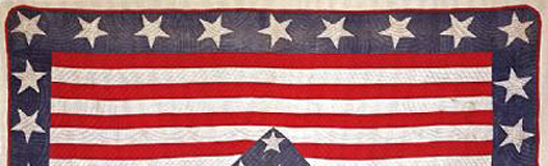
- In 1940 Eugene Teter donated to the Museum this patriotic quilt made by his great-grandmother in 1861 for his grandfather, a Union soldier from Indiana. Mary Rockhold Teter based her pieced and appliquéd quilt on a design published in the July 1861 issue of Peterson's Magazine , a popular women's periodical published in Philadelphia. She personalized it by quilting the name of her son, George Teter, and the names of Generals Scott and Taylor under whom he served. Also found in the quilting are "Abe "and "Ab Lyncoln," "Genral Lyon," the word "Cat" and the year "1861." There are thirty-four stars appliquéd in the center diamond and the same number appliquéd in the border. They represent the number of states in the Union from July 4, 1861 until July 4, 1863, the Civil War years.
- Mary Rockhold was born in Ohio in 1817 and married Thomas E. Teter in 1838. They moved to Indiana in 1846 and had seven children; four daughters died in infancy, three sons attained adulthood. Mary and Thomas were fortunate enough to celebrate their Golden Anniversary in 1888. Mary died in 1897 in Noblesville, Indiana. This "Stars and Stripes" patriotic quilt is a reminder of her devotion to family and country.
- "She was of a family of strong, patriotic Revolutionary stock, and inherited a willingness to do and to labor that the country might grow. Her grand-father was Capt. John Rockhold a native of Pennsylvania, who served in the War for Independence. Her father, Joseph Rockhold, moved from Pennsylvania to Ohio in 1800. He was a captain in the War of 1812. This trait of patriotism was one of the strongest in the character of Mrs. Teter. During the late war she showed her great love for the soldier boys in many ways, aiding in every way she could to encourage and help in the country's peril."
- (From the obituary of Mary Rockhold-Teter, 1897)
- Location
- Currently not on view
- Date made
- 1861
- made for
- Teter, George
- quilter
- Teter, Mary Rockhold
- ID Number
- TE*T08420
- accession number
- 157340
- catalog number
- T08420
- Data Source
- National Museum of American History, Kenneth E. Behring Center
1900 - 1950 Amish "Path Through the Woods" Quilt
- Description
- Quilted in Topeka, Indiana, in the first half of the twentieth century, this is an example of the pattern referred to as “Path through the Woods.” Made of cottons, mainly solid colored tan and red, the blocks are framed by a 2¼-inch red inner border and a 6½-inch tan outer border. The quilt has a blue binding. It is both hand- and machine-pieced; the blocks are joined with machine stitching. An 8-pointed star is quilted in the center of each block. This is an instance of Amish quilting done outside of traditional Pennsylvania areas.
- Location
- Currently not on view
- Date made
- 1900-1950
- quilter
- unknown
- ID Number
- 1985.0029.03
- catalog number
- 1985.0029.03
- accession number
- 1985.0029
- Data Source
- National Museum of American History, Kenneth E. Behring Center

