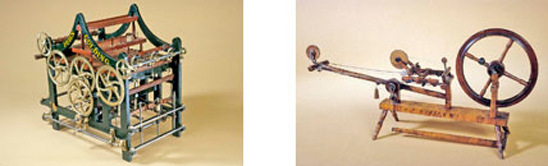
For much of the nineteenth century, inventors submitted a model with their patent application to the United States Patent Office. The National Museum of American History’s patent model collection began with the acquisition of 284 models from the Patent Office in June 1908, and reached more than 1,000 models by the end of that summer. In 1926, Congress decided to dispense with the stored collection of models and gave the Smithsonian Institution the opportunity to collect any models it wanted. Today, the Museum’s collection exceeds 10,000 patent models dating from 1836 to 1910.
The Museum’s Textile Collection contains over four thousand patent models. The collection includes many examples of carding machines, spinning machines, knitting machines, rope making machines, looms, baskets, carpets, fabrics, and sewing machines. Even the simple clothespin is well represented, with 41 patent models.
This sampling of patent models from the Textile Collection describes the two major groupings, textile machinery and sewing machines. In both groups, the examination of the models begins with the earliest of the inventions. In this early group of patent models, the textile machinery models date from 1837 to 1840, and the sewing machine models from 1842 to 1854.
For more information about the Museum’s patent model collection, see Patent Model Index, Guide to the Collections of the National Museum of American History.
Our collection database is a work in progress. We may update this record based on further research and review. Learn more about our approach to sharing our collection online.
If you would like to know how you can use content on this page, see the Smithsonian's Terms of Use. If you need to request an image for publication or other use, please visit Rights and Reproductions.