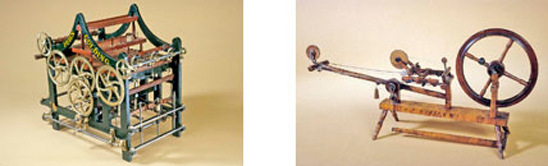
Patent Models: Textile and Sewing Machines - Introduction

For much of the nineteenth century, inventors submitted a model with their patent application to the United States Patent Office. The National Museum of American History’s patent model collection began with the acquisition of 284 models from the Patent Office in June 1908, and reached more than 1,000 models by the end of that summer. In 1926, Congress decided to dispense with the stored collection of models and gave the Smithsonian Institution the opportunity to collect any models it wanted. Today, the Museum’s collection exceeds 10,000 patent models dating from 1836 to 1910.
The Museum’s Textile Collection contains over four thousand patent models. The collection includes many examples of carding machines, spinning machines, knitting machines, rope making machines, looms, baskets, carpets, fabrics, and sewing machines. Even the simple clothespin is well represented, with 41 patent models.
This sampling of patent models from the Textile Collection describes the two major groupings, textile machinery and sewing machines. In both groups, the examination of the models begins with the earliest of the inventions. In this early group of patent models, the textile machinery models date from 1837 to 1840, and the sewing machine models from 1842 to 1854.
For more information about the Museum’s patent model collection, see Patent Model Index, Guide to the Collections of the National Museum of American History.
"Patent Models: Textile and Sewing Machines - Introduction" showing 24 items.
Page 1 of 3
1838 Kimball's Patent Model of a Loom Let-Off and Take-Up
- Description
- Take-Up and Let-Off for Power Looms Patent Model
- Patent No. 758, issued May 30, 1838
- Stephen Kimball of Putney, Vermont
- Kimball’s patent refers to the application of friction to the yarn beam of a power loom. This was accomplished by using a belt, made of steel or iron, which formed nearly a circle around the warp beam. Friction was created by adjusting a screw that caused the circular belt to contract or expand in turn, to increase or decrease the drag on the beam. An elliptical spring eased the movement of the beam within the belt and helped maintain the evenness of the cloth.
- Location
- Currently not on view
- model constructed
- before 1838-05-30
- patent date
- 1838-05-30
- inventor
- Kimball, Stephen
- ID Number
- TE*T11412.002
- catalog number
- T11412.002
- accession number
- 89797
- patent number
- 758
- Data Source
- National Museum of American History, Kenneth E. Behring Center
1838 Angell's Patent Model of a Loom Temple
- Description
- Loom Temple Patent Model
- Patent No. 987, issued October 19, 1838
- Emory A. Angell of Killingly, Connecticut
- In his patent specification, Angell stated that “this temple is of the kind which holds the selvage of the cloth between jaws, which are opened by the beat of the lathe, and is in many respects similar to such as have been long in use.” He claimed, as his invention, the way in which the upper and lower jaws were connected by pins to form the hinge-joints.
- On the original wrapper containing the patent application papers is a faint handwritten note “see Saml. P. Mason’s Temple July 1837.” In the process of checking Angell’s patent, Charles M. Keller, the patent examiner, probably wrote that notation but found no conflict with the Mason patent and thus granted Angell his patent.
- Location
- Currently not on view
- model constructed
- before 1838-10-19
- patent date
- 1838-10-19
- inventor
- Angell, Emory A.
- ID Number
- TE*T11414.013
- catalog number
- T11414.013
- accession number
- 89797
- patent number
- 987
- Data Source
- National Museum of American History, Kenneth E. Behring Center
1837 Thorp's Patent Model of a Loom Shuttle Tongue
- Description
- Loom Shuttle Tongues Patent Model
- Patent No. 162, issued April 17, 1837
- Comfort B. Thorp of Smithfield, Rhode Island
- Comfort Thorp, the younger brother of textile machinery inventor John Thorp, worked for Thomas and William Fletcher in their mill near North Providence. His patent improved the method of securing and holding the cop, or yarn cylinder, on the common power loom shuttle, preventing slips that would waste yarn and cause imperfections in the woven cloth.
- The patent model he submitted contained two types of tongues. One used a common round tongue with wire spiraled around it. The other consisted of a tongue with ridges or notches similar to the teeth of a saw blade. The two loom shuttle tongues were neatly exhibited in a box, probably to keep them from being separated or lost in the cases at the Patent Office.
- Location
- Currently not on view
- model constructed
- before 1837-04-17
- patent date
- 1837-04-17
- inventor
- Thorp, Comfort B.
- ID Number
- TE*T11418.002
- catalog number
- T11418.002
- accession number
- 89797
- patent number
- 162
- Data Source
- National Museum of American History, Kenneth E. Behring Center
1840 Baldwin's Patent Model of a Loom Shuttle
- Description
- Loom Shuttle Patent Model
- Patent No. 1,485, issued on January 31, 1840
- James Baldwin of Nashua, New Hampshire
- Baldwin’s patent consisted of a steel spring and catch made in one piece that fits inside the wooden bobbin. In his patent specification, he claimed this avoided the expense of separate catches and springs that were in the common shuttle as then in use. The arrangement and construction of the spring and catch were such that pushing the bobbin down on the spindle and into the mouth of the shuttle secured the bobbin on the catch. By pulling up on the bobbin, the head of the spindle pushed down on the spring, which in turn disengaged the catch and released the bobbin. These improvements make it easier for the bobbin changer to replenish the shuttle with thread.
- An earlier notice of Baldwin’s loom shuttle appears in the Journal of the American Institute. In 1838, at the eleventh Annual Fair of the American Institute, James and E. Baldwin were awarded a diploma for an improved loom shuttle. On May 3, 1859, James Baldwin was successful in having the shuttle awarded Reissue Patent No. 710.
- Location
- Currently not on view
- model constructed
- before 1840-01-31
- patent date
- 1840-01-31
- inventor
- Baldwin, James
- ID Number
- TE*T11418.011
- catalog number
- T11418.011
- accession number
- 89797
- patent number
- 1,485
- Data Source
- National Museum of American History, Kenneth E. Behring Center
1838 Mason's Patent Model of a Speeder for Roving Cotton
- Description
- Speeder for Roving Cotton Patent Model
- Patent No. 724, issued May 4, 1838
- William Mason of Taunton, Massachusetts
- In 1837, William Mason, who was employed by Crocker and Richmond, developed a speeder (a machine used in cotton yarn spinning) to replace the one that had been invented by George Danforth in 1824.
- Mason’s patent consisted of two parts: the method of removing the full spindle and the centrifugal levers. In 1839, the editor of the Journal of the Franklin Institute stated of the first that it was “ingenious, and manifestly good.” Of the second part, he explained that “by their weight at their outer ends, these levers expanded by the centrifugal force, with a power proportioned to their velocity, causing their inner ends to press upon the spools, and laying the yarn hard and compact upon them; and consequently, admitting of a very high degree of speed.” Although Mason was granted Patent No. 724 for his improvements, it proved difficult to thread and to remove the bobbins.
- Earlier in his career, Mason had devised a loom for weaving diaper cloth and another loom for weaving damask tablecloths. In 1833, he succeeded in perfecting John Thorp’s ring frame to the point where it was later used extensively in the textile industry. He also invented a self-acting cotton spinning machine (Patent No. 1,801, issued October 8, 1840), which for that period was a successful alternative to the contemporary ring spinning machine.
- Mason, with the financial backing of Boston merchant James Kellog Mills, established a machine shop in 1842 called William Mason and Company. Business prospered and in 1845 new buildings were constructed. At that time, Mason’s Taunton shop was considered the largest machine shop in the United States. The shop was particularly successful in manufacturing cotton machinery, as well as machine tools, cupola furnaces, blowers, rifles, Campbell printing presses, gears, and shafts.
- Mason found new fame in 1852 when he began building locomotives, the first of which was finished in 1853. His locomotives found wide acceptance for the beauty of design and technical excellence. Mason was a pioneer inventor and manufacturer whose ideas, manufacturing methods, and products had a profound influence on American technology.
- Location
- Currently not on view
- model constructed
- before 1838-05-04
- patent date
- 1838-05-04
- inventor
- Mason, William
- ID Number
- TE*T11421.043
- accession number
- 89797
- catalog number
- T11421.043
- patent number
- 000724
- Data Source
- National Museum of American History, Kenneth E. Behring Center
1838 Fairman's Patent Model of a Loom
- Description
- Power Loom Patent Model
- Patent No. 595, issued February 6, 1838
- Elijah Fairman of Stafford, Connecticut
- Fairman’s improvements, consisting of an additional cam and a set of treadles, were applied to power looms in common use. His improvements allowed the harnesses to operate more smoothly and the warp to open, enabling the shuttle to pass more easily. The end result was that the loom was better suited to weaving either light or heavy fabrics. Six pages and three illustrations in Clinton Gilroy’s 1844 book, The Art of Weaving, are spent in describing Fairman’s patent. Gilroy commented that Fairman’s loom would probably work fine for simple weaves, but for fancy patterned work, requiring 10 to 100 heddle frames, it would be totally impractical.
- Location
- Currently not on view
- model constructed
- before 1838-02-06
- patent date
- 1838-02-06
- inventor
- Fairman, Elijah
- ID Number
- TE*T11411.095
- accession number
- 89797
- catalog number
- T11411.095
- patent number
- 595
- Data Source
- National Museum of American History, Kenneth E. Behring Center
1837 Harvey's Patent Model of a Hair Cloth Loom
- Description
- Hair Cloth Loom Patent Model
- Patent No. 490, issued November 25, 1837
- Charles R. Harvey of Poughkeepsie, New York
- Weaving with horsehair was difficult and slow because the weaver had to select an individual horsehair for each weft and insert it into the warp. Harvey’s loom was a step toward mechanizing this process. But Harvey dealt only with changing from a hand loom to a power loom, not with the problem of weaving with horsehair. Even in his patent specification, he mentioned that the “hook” (a simple wooden rod with a hook at one end by which the horsehair was drawn in to be woven) is “made in the usual way.” Harvey detailed his improvements as the application of power to both the movement of the hook and the operation of the loom overall.
- At the tenth Annual Fair of the American Institute in 1837, Harvey was awarded a gold medal for his “hair seating loom.” The Journal of the American Institute, published in 1838, remarked that “this is the first application of power to weaving hair cloth; and concerning the extent of the article [hair cloth] now used for furniture, we think the loom is entitled to the highest consideration.”
- Location
- Currently not on view
- model constructed
- before 1837-11-25
- patent date
- 1837-11-25
- inventor
- Harvey, Charles R.
- ID Number
- TE*T11411.035
- accession number
- 89797
- catalog number
- T11411.035
- patent number
- 490
- Data Source
- National Museum of American History, Kenneth E. Behring Center
1838 Bigelow's Patent Model of a Loom
- Description
- Loom for Weaving Knotted Counterpanes Patent Model
- Patent No. 546, issued January 6, 1838
- Erastus B. Bigelow of West Boylston, Massachusetts
- Erastus B. Bigelow primarily claimed the mechanism that raised the knots that formed the figures or patterns on the counterpane. His patent specification was lengthy, five pages of drawings and nine pages of written specifications.
- In 1840, the editor of the Journal of the Franklin Institute wrote, “. . . the goods produced in this loom are of a quality very superior to such as are produced in the hand loom; at all events we have not met with any thing of the kind in the shops that will compare with them for texture, and for beauty and regularity of pattern. . . . We anticipate that at a very early day, American counterpanes will become as general as berths on board steamboats, and as beds at hotels. The articles are for sale in all our large cities, and as soon as there is a sufficient supply, will make their way into every part of the Union.”
- Bigelow was a prolific inventor, patenting at least 33 loom improvements. In 1842 he revolutionized carpet manufacture by a series of inventions that made the carpet loom automatic. The automatic features enabled manufacturers to replace male weavers with less costly female weavers or boys. His inventions for the power weaving of Brussels, Jacquard, Ingrain, and Wilton carpet were quite successful. Before the mid-19th century, the importance of these inventions was recognized both in the United States and in Europe.
- Location
- Currently not on view
- model constructed
- before 1838-01-06
- patent date
- 1838-01-06
- inventor
- Bigelow, Erastus Brigham
- ID Number
- TE*T11411.128
- accession number
- 89797
- catalog number
- T11411.128
- patent number
- 546
- Data Source
- National Museum of American History, Kenneth E. Behring Center
1840 Thorp and Angell's Patent Model of a Loom Heddle
- Description
- Loom Heddles Patent Model
- Patent No. 1,498, issued on February 26, 1840
- John Thorp and William G. Angell of Providence, Rhode Island
- These heddles, both wire and twine, were exhibited in the Patent Office in a round wooden frame. In the patent specification, Thorp and Angell described the dimensions of heddles for use on a common power loom. A chain of the heddles was formed by taking two pieces of wire or twine and tying them with a common square knot, “which will unite them in the same way and manner that a lady ties her apron strings or a child his shoestrings.” The placement of the knots resulted in the formation of the eyes of the heddles, which raise and lower warp threads in weaving cloth.
- Thorp and Angell did not include a patent drawing with the specification. The 1841 Journal of the Franklin Institute remarked of this omission: “We must suppose . . . that the description, although to us somewhat obscure, would be clear to a professional weaver.”
- Location
- Currently not on view
- model constructed
- before 1840-02-26
- patent date
- 1840-02-26
- inventor
- Thorp, John
- Angell, William G.
- ID Number
- TE*T11409.032
- catalog number
- T11409.032
- accession number
- 89797
- patent number
- 1,498
- Data Source
- National Museum of American History, Kenneth E. Behring Center
1839 Pratt's Patent Model of a Reeling, Spinning, and Twisting Silk Machine
- Description
- Reeling, Spinning, and Twisting Silk Machine Patent Model
- Patent No. 1,367, issued October 12, 1839
- Jacob Pratt of Sherborn, Massachusetts
- Pratt is an example of an inventor who thought he had a more complicated original invention than he actually had. In his patent application file, his specification makes four claims. Out of those four, only one was approved by Charles M. Keller, the patent examiner, and that claim was for using a trough of zinc. The trough held spools of silk fibers prior to spinning and was filled with warm water, which kept the fibers from sticking together.
- The Journal of the Franklin Institute, 1840, commented: “Its construction is, in general, similar to such as is well known, and is not claimed as new . . . No particular reason is given for making the troughs of zinc, and we suppose that copper would do equally well; but from the special mention of this metal we were led to look for some ground of preference to it.”
- Location
- Currently not on view
- model constructed
- before 1839-10-12
- patent date
- 1839-10-12
- inventor
- Pratt, Jacob
- ID Number
- TE*T11426.020
- accession number
- 89797
- catalog number
- T11426.020
- patent number
- 001367
- Data Source
- National Museum of American History, Kenneth E. Behring Center