Science & Mathematics - Overview

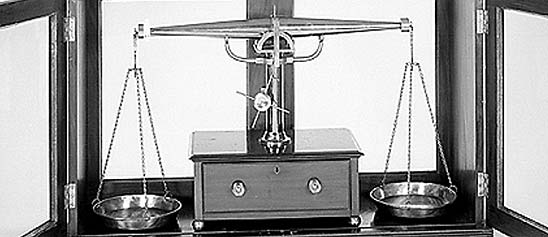
The Museum's collections hold thousands of objects related to chemistry, biology, physics, astronomy, and other sciences. Instruments range from early American telescopes to lasers. Rare glassware and other artifacts from the laboratory of Joseph Priestley, the discoverer of oxygen, are among the scientific treasures here. A Gilbert chemistry set of about 1937 and other objects testify to the pleasures of amateur science. Artifacts also help illuminate the social and political history of biology and the roles of women and minorities in science.
The mathematics collection holds artifacts from slide rules and flash cards to code-breaking equipment. More than 1,000 models demonstrate some of the problems and principles of mathematics, and 80 abstract paintings by illustrator and cartoonist Crockett Johnson show his visual interpretations of mathematical theorems.
"Science & Mathematics - Overview" showing 11 items.
Page 1 of 2
Test Tube
- Description
- The test tube is one of the most commonly used pieces of laboratory ware, available in many sizes ranging from less than 1 inch to 6 inches in length. The test tube was developed by Michael Faraday (1791-1867), the renowned British physicist and chemist, to replace the much larger wine glass test glass. Test tubes are the perfect shape and size to hold small amounts of substances, usually liquid, which are then manipulated in some way, such as being placed over the flame of a Bunsen burner.
- The test tube has changed little since the early 19th century, although it is now made of plastic as well as glass.
- Location
- Currently not on view
- ID Number
- 1985.0311.419
- catalog number
- 1985.0311.419
- accession number
- 1985.0311
- Data Source
- National Museum of American History, Kenneth E. Behring Center
Test Tube
- Description
- The test tube is one of the most commonly used pieces of laboratory ware, available in many sizes ranging from less than 1 inch to 6 inches in length. The test tube was developed by Michael Faraday (1791-1867), the renowned British physicist and chemist, to replace the much larger wine glass test glass. Test tubes are the perfect shape and size to hold small amounts of substances, usually liquid, which are then manipulated in some way, such as being placed over the flame of a Bunsen burner.
- The test tube has changed little since the early 19th century, although it is now made of plastic as well as glass.
- Location
- Currently not on view
- ID Number
- 1985.0311.420
- catalog number
- 1985.0311.420
- accession number
- 1985.0311
- Data Source
- National Museum of American History, Kenneth E. Behring Center
Test Tube
- Description
- The test tube is one of the most commonly used pieces of laboratory ware, available in many sizes ranging from less than 1 inch to 6 inches in length. The test tube was developed by Michael Faraday (1791-1867), the renowned British physicist and chemist, to replace the much larger wine glass test glass. Test tubes are the perfect shape and size to hold small amounts of substances, usually liquid, which are then manipulated in some way, such as being placed over the flame of a Bunsen burner.
- The test tube has changed little since the early 19th century, although it is now made of plastic as well as glass.
- Location
- Currently not on view
- ID Number
- CH*315121.054
- catalog number
- 315121.054
- accession number
- 215563
- Data Source
- National Museum of American History, Kenneth E. Behring Center
Test Tube
- Description
- The test tube is one of the most commonly used pieces of laboratory ware, available in many sizes ranging from less than 1 inch to 6 inches in length. The test tube was developed by Michael Faraday (1791-1867), the renowned British physicist and chemist, to replace the much larger wine glass test glass. Test tubes are the perfect shape and size to hold small amounts of substances, usually liquid, which are then manipulated in some way, such as being placed over the flame of a Bunsen burner.
- The test tube has changed little since the early 19th century, although it is now made of plastic as well as glass.
- Location
- Currently not on view
- ID Number
- CH*315121.055
- catalog number
- 315121.055
- accession number
- 215563
- Data Source
- National Museum of American History, Kenneth E. Behring Center
Test Tube
- Description
- The test tube is one of the most commonly used pieces of laboratory ware, available in many sizes ranging from less than 1 inch to 6 inches in length. The test tube was developed by Michael Faraday (1791-1867), the renowned British physicist and chemist, to replace the much larger wine glass test glass. Test tubes are the perfect shape and size to hold small amounts of substances, usually liquid, which are then manipulated in some way, such as being placed over the flame of a Bunsen burner.
- The test tube has changed little since the early 19th century, although it is now made of plastic as well as glass.
- Location
- Currently not on view
- ID Number
- CH*315121.056
- catalog number
- 315121.056
- accession number
- 215563
- Data Source
- National Museum of American History, Kenneth E. Behring Center
Test Tube
- Description
- The test tube is one of the most commonly used pieces of laboratory ware, available in many sizes ranging from less than 1 inch to 6 inches in length. The test tube was developed by Michael Faraday (1791-1867), the renowned British physicist and chemist, to replace the much larger wine glass test glass. Test tubes are the perfect shape and size to hold small amounts of substances, usually liquid, which are then manipulated in some way, such as being placed over the flame of a Bunsen burner.
- The test tube has changed little since the early 19th century, although it is now made of plastic as well as glass.
- Location
- Currently not on view
- ID Number
- CH*315121.057
- catalog number
- 315121.057
- accession number
- 215563
- Data Source
- National Museum of American History, Kenneth E. Behring Center
Test Tube
- Description
- The test tube is one of the most commonly used pieces of laboratory ware, available in many sizes ranging from less than 1 inch to 6 inches in length. The test tube was developed by Michael Faraday (1791-1867), the renowned British physicist and chemist, to replace the much larger wine glass test glass. Test tubes are the perfect shape and size to hold small amounts of substances, usually liquid, which are then manipulated in some way, such as being placed over the flame of a Bunsen burner.
- The test tube has changed little since the early 19th century, although it is now made of plastic as well as glass.
- Location
- Currently not on view
- ID Number
- CH*315121.060
- catalog number
- 315121.060
- accession number
- 215563
- Data Source
- National Museum of American History, Kenneth E. Behring Center
Test Tube
- Description
- The test tube is one of the most commonly used pieces of laboratory ware, available in many sizes ranging from less than 1 inch to 6 inches in length. The test tube was developed by Michael Faraday (1791-1867), the renowned British physicist and chemist, to replace the much larger wine glass test glass. Test tubes are the perfect shape and size to hold small amounts of substances, usually liquid, which are then manipulated in some way, such as being placed over the flame of a Bunsen burner.
- The test tube has changed little since the early 19th century, although it is now made of plastic as well as glass.
- Location
- Currently not on view
- ID Number
- CH*315121.061
- catalog number
- 315121.061
- accession number
- 215563
- Data Source
- National Museum of American History, Kenneth E. Behring Center
Test Tube
- Description
- The test tube is one of the most commonly used pieces of laboratory ware, available in many sizes ranging from less than 1 inch to 6 inches in length. The test tube was developed by Michael Faraday (1791-1867), the renowned British physicist and chemist, to replace the much larger wine glass test glass. Test tubes are the perfect shape and size to hold small amounts of substances, usually liquid, which are then manipulated in some way, such as being placed over the flame of a Bunsen burner.
- The test tube has changed little since the early 19th century, although it is now made of plastic as well as glass.
- Location
- Currently not on view
- ID Number
- CH*315121.062
- catalog number
- 315121.062
- accession number
- 215563
- Data Source
- National Museum of American History, Kenneth E. Behring Center
Test Tube
- Description
- The test tube is one of the most commonly used pieces of laboratory ware, available in many sizes ranging from less than 1 inch to 6 inches in length. The test tube was developed by Michael Faraday (1791-1867), the renowned British physicist and chemist, to replace the much larger wine glass test glass. Test tubes are the perfect shape and size to hold small amounts of substances, usually liquid, which are then manipulated in some way, such as being placed over the flame of a Bunsen burner.
- The test tube has changed little since the early 19th century, although it is now made of plastic as well as glass.
- Location
- Currently not on view
- ID Number
- CH*315121.063
- catalog number
- 315121.063
- accession number
- 215563
- Data Source
- National Museum of American History, Kenneth E. Behring Center
- Next Page

