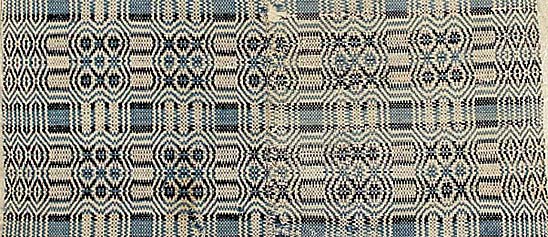
Textiles - Overview

The 50,000 objects in the textile collections fall into two main categories: raw fibers, yarns, and fabrics, and machines, tools, and other textile technology. Shawls, coverlets, samplers, laces, linens, synthetics, and other fabrics are part of the first group, along with the 400 quilts in the National Quilt Collection. Some of the Museum's most popular artifacts, such as the Star-Spangled Banner and the gowns of the first ladies, have an obvious textile connection.
The machinery and tools include spinning wheels, sewing machines, thimbles, needlework tools, looms, and an invention that changed the course of American agriculture and society. A model of Eli Whitney's cotton gin, made by the inventor in the early 1800s, shows the workings of a machine that helped make cotton plantations profitable in the South and encouraged the spread of slavery.
"Textiles - Overview" showing 3 items.
1750 - 1800 Copp Family's Indigo Wool Quilt
- Description
- This indigo wool quilt is one of three late-eighteenth-and-early nineteenth-century quilts that were donated in the 1890s by John Brenton Copp of Stonington, Connecticut. All are part of an extensive gift of household textiles, costume items, furniture, and other objects that belonged to his family from 1750 to 1850. The Copp Collection continues to provide insights into New England family life of that period.
- Whole cloth quilts were most popular between 1775 and 1840, although before 1800 they were relatively rare and expensive. This eighteenth-century example from the Copp family is a glazed indigo wool quilt. The fabric was dyed blue with indigo, one of the oldest dyes used for textiles. Glazing, a process involving the use of a hot press on wool fabric, resulted in a smooth, lustrous surface. The lining, a butternut-colored wool, apparently was made from two different blankets.
- It is quilted with a popular motif of the period, a large pineapple, using blue wool thread, 7 stitches per inch. A quilted flowering vine extends from a basket at the bottom edge of the quilt and frames the pineapple. A family member, John Brown Copp (b. 1779), was known to have drawn designs for white counterpanes for the young ladies in the Stonington area. The quilting pattern on this indigo wool quilt is similar to the embroidery pattern of a white counterpane, from about 1800, which also belonged to the Copp family.
- An analysis of the household textile collection donated by John Brenton Copp can be found in the Copp Family Textiles by Grace Rogers Cooper (Smithsonian Institution Press, 1971). In the book the author summarizes the family background. “The first Copp to reach America was William, a 26-year-old London shoemaker who in 1635 set out for the Massachusetts Colony on the good ship Blessing. He landed east of Boston and became the first owner of Copp’s Hill in north Boston . . . . William’s son Jonathan established the Connecticut branch of the family around Stonington later in the seventeenth century. Many of his male descendents gained comfortable prosperity as merchants and businessmen, while their wives and daughters led full lives as mothers of the large families in which education and refinement were encouraged . . . . The long succession of Jonathans, Samuels, Catherines, Esters, Marys, and Sarahs makes it rather difficult to set in order the generations and their contributions to the collection.” The exact maker of this indigo wool quilt is unidentified, but it was probably made by one or more members of the Copp household.
- Location
- Currently not on view
- date made
- 1750-1800
- maker
- Copp Family
- ID Number
- TE*H006643
- accession number
- 28810
- catalog number
- H006643
- Data Source
- National Museum of American History, Kenneth E. Behring Center
1790 - 1810 Copp Family's "Nine-patch" Pieced Quilt
- Description
- This quilt is one of three late-eighteenth-and-early-nineteenth-century quilts that were donated in the 1890s by John Brenton Copp of Stonington, Connecticut. All are a part of an extensive gift of household textiles, costume items, furniture, and other objects that belonged to his family from 1750 to 1850. The Copp Collection continues to provide insights into New England family life of that period.
- The pieced blocks on this quilt, a variation of the “Nine-patch” pattern, are each made of one of nine different block-printed cottons. These are symmetrically arranged according to the particular print, and alternate with plain white blocks. The quilting pattern consists of parallel diagonal lines on the pieced blocks contrasting with 1½-inch shells on the white blocks, all quilted at 7 stitches per inch.
- An analysis of the household textile collection donated by John Brenton Copp can be found in the Copp Family Textiles by Grace Rogers Cooper (Smithsonian Institution Press, 1971). In the book the author summarizes the family background. “The first Copp to reach America was William, a 26-year-old London shoemaker who in 1635 set out for the Massachusetts Colony on the good ship Blessing. He landed east of Boston and became the first owner of Copp’s Hill in north Boston . . . . William’s son Jonathan established the Connecticut branch of the family around Stonington later in the seventeenth century. Many of his male descendents gained comfortable prosperity as merchants and businessmen, while their wives and daughters led full lives as mothers of the large families in which education and refinement were encouraged . . . . The long succession of Jonathans, Samuels, Catherines, Esters, Marys, and Sarahs makes it rather difficult to set in order the generations and their contributions to the collection.” The exact maker of this “Nine-patch” quilt is unidentified, but it was probably made by one or more members of the Copp household.
- Location
- Currently not on view
- date made
- 1790-1810
- maker
- Copp Family
- ID Number
- TE*H006679
- accession number
- 28810
- catalog number
- H006679
- Data Source
- National Museum of American History, Kenneth E. Behring Center
1790 - 1810 Copp Family's Framed Center Pieced Quilt
- Description
- This pieced-work example is one of three late-eighteenth-and-early nineteenth-century quilts that were donated in the 1890s by John Brenton Copp of Stonington, Connecticut. All are a part of an extensive gift of household textiles, costume items, furniture and other objects that belonged to his family from 1750 to 1850. The Copp Collection continues to provide insights into New England family life of that period.
- The arrangement of the pattern of this quilt is one found frequently in eighteenth-century and early-nineteenth-century quilts, a succession of borders framing a center panel of pieced work. A view of the pieced center of this quilt seen from the right side, suggests the shape of a tree, and the printed fabrics repeat in mirror fashion in each row about ninety percent of the time. Perhaps the center was erroneously placed in this direction, or it was meant to be viewed from the bedside. The lining is pieced of much-mended linen and cotton fabrics that originally were probably sheets. On one piece, the initials “HV” are cross-stitched in tan silk thread. It is quilted in an overall herringbone pattern, 5 or 6 stitches per inch.
- The clothing and furnishing fabrics used in the quilt top span a period of about forty years. This, and the fact that the Copp family was in the dry goods business, may explain why the quilt includes more than one hundred and fifty different printed, woven-patterned, and plain fabrics of cotton, linen and silk. Although the array of fabrics is extravagant, economy is evident in the use of even the smallest scraps. Many blocks in the quilt pattern are composed of several smaller, irregularly shaped pieces. Two dresses, in the Copp Collection, one from about 1800 and the other from about 1815, are made of fabrics that appear in the quilt.
- An analysis of the household textile collection donated by John Brenton Copp can be found in the Copp Family Textiles by Grace Rogers Cooper (Smithsonian Institution Press, 1971). In the book the author summarizes the family background. “The first Copp to reach America was William, a 26-year-old London shoemaker who in 1635 set out for the Massachusetts Colony on the good ship Blessing. He landed east of Boston and became the first owner of Copp’s Hill in north Boston . . . . William’s son Jonathan established the Connecticut branch of the family around Stonington later in the seventeenth century. Many of his male descendents gained comfortable prosperity as merchants and businessmen, while their wives and daughters led full lives as mothers of the large families in which education and refinement were encouraged . . . . The long succession of Jonathans, Samuels, Catherines, Esters, Marys, and Sarahs makes it rather difficult to set in order the generations and their contributions to the collection.” The exact maker of this quilt is unidentified, but it was probably made by one or more members of the Copp household.
- Location
- Currently not on view
- date made
- 1790-1810
- maker
- Copp Family
- ID Number
- TE*H006680
- accession number
- 28810
- catalog number
- H006680
- Data Source
- National Museum of American History, Kenneth E. Behring Center