Textiles - Overview

The 50,000 objects in the textile collections fall into two main categories: raw fibers, yarns, and fabrics, and machines, tools, and other textile technology. Shawls, coverlets, samplers, laces, linens, synthetics, and other fabrics are part of the first group, along with the 400 quilts in the National Quilt Collection. Some of the Museum's most popular artifacts, such as the Star-Spangled Banner and the gowns of the first ladies, have an obvious textile connection.
The machinery and tools include spinning wheels, sewing machines, thimbles, needlework tools, looms, and an invention that changed the course of American agriculture and society. A model of Eli Whitney's cotton gin, made by the inventor in the early 1800s, shows the workings of a machine that helped make cotton plantations profitable in the South and encouraged the spread of slavery.
"Textiles - Overview" showing 684 items.
Page 4 of 69
1840 - 1860 "LeMoyne Star" Pieced Quilt
- Description
- The pieces that are used to make the 71 “LeMoyne Star” blocks on this quilt create a useful record. They represent an assortment of fabrics used for ordinary mid-19th century clothes. Brown, tan, grey, and rust-colored fabrics, most twill-woven cotton/wool, were used to piece the blocks. These alternate with 6 ½-inch squares of brown and grey striped cotton/wool fabric. The quilt is lined with a plain-weave, cotton warp/wool weft fabric. Brown carded wool serves as the filling. The quilting pattern consists of parallel diagonal lines 1 ½-inch apart, quilted at 3-4 stitches per inch.
- The machine- and hand-woven textile examples might not otherwise have been preserved if not used to craft this quilt.
- Location
- Currently not on view
- date made
- 1840-1860
- maker
- unknown
- ID Number
- 1979.0167.01
- catalog number
- 1979.0167.01
- accession number
- 1979.0167
- Data Source
- National Museum of American History, Kenneth E. Behring Center
1760 Eve Van Cortlandt's Quilted Counterpane
- Description
- Eve Van Cortlandt's fine white linen quilted counterpane is one of the earliest dated American quilts in existence. The date, "1760" and her initials, "E V C," are embroidered in blue silk cross-stitch on the quilt lining. Quilted with white linen thread, a delicate pattern of flowers, feathery stems, and low open baskets surround a central quatrefoil medallion. The design is set off by a background of quilted parallel lines just one-eighth inch apart.
- Eve was born on May 22, 1736, to Frederick Van Cortlandt and Francena Jay each from families of wealthy and prominent New York landowners. She made her quilt for her dower chest while living in the family home. In 1761, Eve married the Honorable Henry White, a businessman and a member of the King’s Council of the Royal Colony of New York. He became president of the New York Chamber of Commerce in 1772 and remained loyal to the King of England during the Revolution.
- When the British evacuated New York in 1783, Henry moved his family to England. Henry White died in London in 1786, and Eve returned to America as a widow, most likely to be near two of her children who lived in New York. Of their five children, two sons were in the British service and remained in London, as did one daughter. Eve died in 1836 at the age of one hundred, having witnessed a century of historic events. Since 1897, the family home in Van Cortlandt Park in the Bronx has been a museum.
- Location
- Currently not on view
- Date made
- 1760
- quilter
- Van Cortlandt, Eve
- ID Number
- 1979.0184.01
- catalog number
- 1979.0184.01
- accession number
- 1979.0184
- Data Source
- National Museum of American History, Kenneth E. Behring Center
1784 Overshot Coverlet
- Description
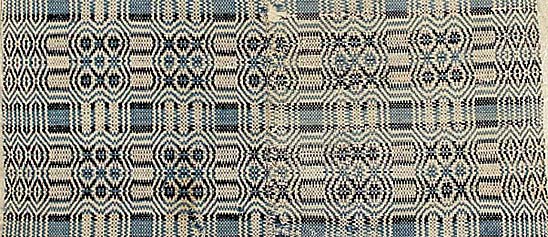
- The weaver and original owner of this very complex, well worn, single-woven, linen, cotton and wool, overshot coverlet, dated 1784, are unknown. The letters “E M” and the date are woven into the coverlet on the lower right hand side, using a hand technique. We do not know if
- “E M” stands for name of the owner or the weaver. In the 18th century it was not unusual for textiles to be marked with the initials of the owner, but it was usually done with embroidery. The initials identified the coverlet as the woman's property. Women could own and inherit "moveable" property.
- The overall patterns used in this coverlet are “Rose” and “Tables,” and there are two shades of indigo blue used in a band effect. The coverlet was woven in two sections, and then sewn together. The original size of the sections and the coverlet as a whole are unknown, as there are no original edges present. This coverlet was found in Massachusetts. In the18th century, a young woman might commission the weaving of a coverlet or receive one as a gift, and put it in her dowry (hope chest) saving it for use after marriage.
- Location
- Currently not on view
- date made
- 1784
- maker
- unknown
- ID Number
- 1979.0723.1
- accession number
- 1979.0723
- catalog number
- 1979.0723.1
- Data Source
- National Museum of American History, Kenneth E. Behring Center
Overshot Coverlet 1787
- Description
- The date 1787 and the letters “M S” are woven into a corner of this cotton, linen, and wool, single-woven overshot coverlet. The center seam indicates the coverlet was woven in two sections that were sewn together. One section is an inch smaller than the other. The pattern could be a variation of “Kings Flower” pattern or “Roses and Tables.” This Coverlet was found in New York State. It is not known if “M S” are the initials of the weaver or the owner, both of whom are unknown. In the 18th century, household textiles were prized possessions, and it was not unusual for them to be marked with the owner’s initials and the date. However, the marking was usually done with embroidery.
- Location
- Currently not on view
- date made
- 1787
- maker
- unknown
- ID Number
- 1979.0723.2
- accession number
- 1979.0723
- catalog number
- 1979.0723.2
- Data Source
- National Museum of American History, Kenneth E. Behring Center
1840 - 1860 Catherine Byer's Pieced and Appliqued Quilt
- Description
- Inked leaves and a bird frame the inscription: “Eby – Byers Catherine Byers” and the place, “Chambersburg.” Below Chambersburg is noted "1837," but in a different color ink---possibly a later addition? Did Catherine make this quilt?
- Catherine Byers, born in 1805, was the daughter of Frederick Byers and Anna Eby of Pa. Catherine married James Crawford (1799-1872). They raised their children and lived on the family homestead in Franklin County, Pa. Catherine died in 1892. Both came from families who were early settlers of Pennsylvania, some of whom had fought in the Revolutionary War.
- Thirty-six pieced blocks, each with a center square of dark blue printed cotton and three appliquéd leaves at each corner create a unique pattern. The central focus is the 9 ¾-inch-block with the inked drawing and inscription. The quilt is framed by a 6-inch border and is quilted at 10 stitches per inch. As no information was included with the quilt, it is difficult to know who made the quilt and the significance of the date.
- Location
- Currently not on view
- date made
- 1840-1860
- maker
- Byers, Catherine
- ID Number
- 1980.0253.01
- catalog number
- 1980.0253.01
- accession number
- 1980.0253
- Data Source
- National Museum of American History, Kenneth E. Behring Center
Sukey Foster's Sampler
- Description
- One script alphabet with letters colored in pairs; no "J"; three rows separated by simple crossbands. Below verse, three flowering plants (one in vase) and two-story building with four chimneys standing next to tree on hill. Center section outlined by three sawtoothed bands and short strawberry-vine band. Border of wide geometric flowering vine on top and two sides, and band of shaded satin stitches across bottom. Silk embroidery thread on linen ground. STITCHES: cross, crosslet, chain, detached chain, petit point, outline, satin, hem. THREAD COUNT: warp 32, weft 28/in.
- Inscriptions:
- "The fairest flower will soon decay
Its fragrant loose and splended hue
So youth and beauty wear away
And vanish is the morning dew
- Sukey Fosters Work
Wrought in the tWelfth
Year of her age
Cambridge
August 20 1803"
- Background:
- Sukey was born on March 10, 1791, to James and Sukey Foster in Hopkinton, Massachusetts. She married William Adams on September 17, 1818, and they had four children—Susan Ann, William, Hannah Foster, and Mary Jane. Sukey died in West Cambridge, Massachusetts, on September 13, 1846. Her sampler descended in the family of her son William.
- Location
- Currently not on view
- Date made
- 1803
- maker
- Foster, Sukey
- ID Number
- 1980.0849.01
- accession number
- 1980.0849
- catalog number
- 1980.0849.01
- Data Source
- National Museum of American History, Kenneth E. Behring Center
Linen Overshot Coverlet 1790
- Description
- Elizabeth Deuel is said to have made this single-woven, all linen coverlet in1790, in the Saratoga region of New York State. Her name and the date are cross-stitched into the lower edge of the coverlet just above the fringe. A search of the 1790 census of the area produced no one with the surname Deuel. More research is needed to determine where Miss Deuel lived, and if she was the weaver or the owner of this coverlet. In the 18th century, it was common for household textiles to be marked with the initials or name of the owner and the date. The average colonial home did not have a great number of household textiles, and they were considered important possessions. This coverlet was woven in two sections that were then sewn together.
- Location
- Currently not on view
- date made
- late 18th century
- 1790
- weaver or owner
- Deuel, Elizabeth
- maker or owner of coverlet
- Deuel, Elizabeth
- ID Number
- 1981.0274.005
- accession number
- 1981.0274
- catalog number
- 1981.0274.05
- Data Source
- National Museum of American History, Kenneth E. Behring Center
Rose of Sharon Coverlet
- Description
- The weaver of this single-woven overshot coverlet is unknown. It is made entirely of wool, and was probably woven in the late 18th or early 19th century. The pattern used is similar to the patterns known as “Rose of Sharon” and “Freeman’s Felicity.” It was woven in two sections and sewn together. The lower edge has an applied fringe, while the one on the side is a self fringe. In the 18th and early 19th centuries, it was common for women to spin fiber into yarn, and take the yarn to a professional weaver for use in a coverlet. In the late 18th and early 19th centuries, household textiles were precious belongings, frequently listed in household inventories right along with furniture and tools.
- Location
- Currently not on view
- date made
- 1790-1810
- late 18th century
- early 19th century
- maker
- unknown
- ID Number
- 1981.0274.008
- accession number
- 1981.0274
- catalog number
- 1981.0274.08
- Data Source
- National Museum of American History, Kenneth E. Behring Center
1800 - 1850 Pieced Quilt
- Description
- The 17-inch center block of this 18th-century quilt is appliquéd with a charming array of floral, geometric, and heart-shaped designs. It is surrounded by five pieced borders.
- Block-printed, copperplate-printed, Indian-painted, and roller-printed techniques are represented in the fabrics that were used for piecing. Plain-woven and pattern-woven white cottons are also evident. The 8 ½-inch blocks that make up the borders are pieced in a variety of patterns popular in the first half of the 19th century. It has a cotton filling and is quilted, 7 stitches/inch.
- The quilt is probably from southern New England, possibly Connecticut, where it was found. The many, many fabrics, different pieced block patterns, and appliquéd designs contribute to this sampler of 19th- century quilt making.
- Location
- Currently not on view
- date made
- 1800-1850
- maker
- unknown
- ID Number
- 1981.0417.04
- catalog number
- 1981.0417.04
- accession number
- 1981.0417
- Data Source
- National Museum of American History, Kenneth E. Behring Center
1800 - 1815 Indigo Wool Quilt
- Description
- This example of an early 19th-century whole cloth quilt has an unusual design. Four sprays of large flowers, leaves, and clusters of berries begin in each of the corners and meet in the center of the quilt. They are framed by a wide scrolling vine with a 2 ½ -inch feathered band along the outer edge.
- The fabric for this quilt was dyed blue with indigo, one of the oldest dyes used for textiles. Glazing, a process involving the use of a hot press on wool fabric, resulted in a smooth, lustrous fabric surface.
- The motifs in the design are all outline quilted, 8-9 stitches/inch. The background, parallel diagonal lines quilted ¼-inch apart, further enhances the overall design. The lining is a tan and blue plaid wool/cotton fabric. There is no binding the front and lining are turned in and sewn with a running stitch.
- Location
- Currently not on view
- date made
- 1800-1815
- maker
- unknown
- ID Number
- 1981.1020.08
- catalog number
- 1981.1020.08
- accession number
- 1981.1020
- Data Source
- National Museum of American History, Kenneth E. Behring Center

