The Abacus and the Numeral Frame - The Japanese Abacus

Most recent Japanese abaci (soroban) have one counter above and four below. Some older Japanese instruments have five counters in the lower section. The right-most column represents units, the next tens, the next hundreds, etc. For numbers with digits to the right of the decimal point, the first column is for the smallest decimal term. In multiplication, some columns are used for the number being multiplied and some for the product. In part for this reason, there are more columns on most abaci than are usually used in addition. In any calculation, the counters that represent numbers are those moved against the crossbar.
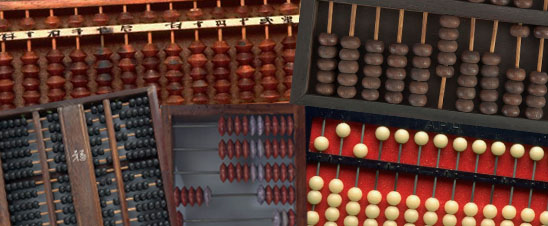
"The Abacus and the Numeral Frame - The Japanese Abacus" showing 4 items.
Soroban, or Japanese Abacus
- Description
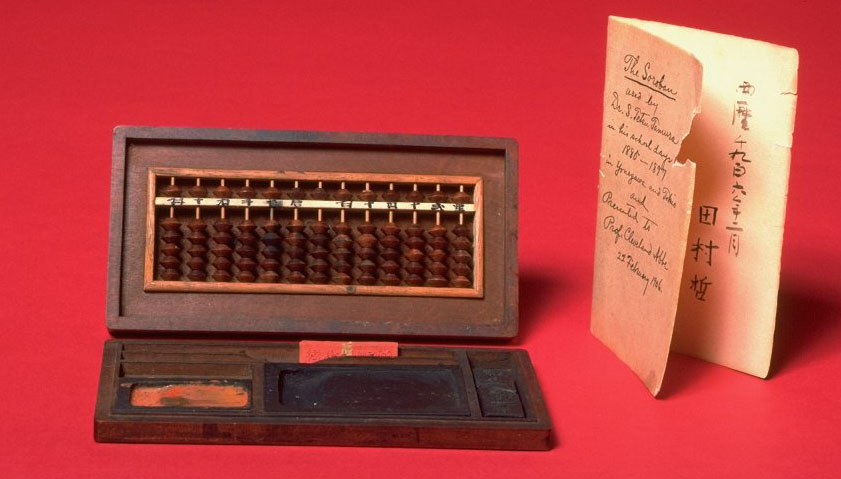
- This Japanese abacus is in the lid of a rosewood box. A wooden cross bar colored white is painted with various characters labeling various columns of the abacus. Columns 1 to 6 are labeled in units of volume used to measure rice. Columns 8 through 13 are labeled in units of Japanese currency. Column 7 is not labeled.
- The beads of the abacus move on 13 parallel bamboo rods, with one bead above the cross bar and five below. The shape of the beads is like that of other Japanese abaci. The base of the box contains a large container with hardened black ink, a smaller container with red ink, additional bars of red and black ink, and a brush for drawing characters.
- A paper sheet received with the abacus indicates that it was used by Dr. S. Tetsu Tamura as a schoolboy from 1885 to 1897 and presented to Cleveland Abbe in 1906.
- Location
- Currently not on view
- Date made
- ca 1885
- ID Number
- 1979.0876.04
- catalog number
- 1979.0876.04
- accession number
- 1979.0876
- Data Source
- National Museum of American History, Kenneth E. Behring Center
Soroban, or Japanese Abacus
- Description
- This wooden instrument has an open frame and is stored in an open wooden box. The frame (which lifts out of the box) has a cross bar and holds 21 parallel bamboo rods. Each rod holds one bead above the cross bar and five below. The beads have a similar shape to those of other Japanese abaci. All the columns of the abacus except the center one are labeled with Japanese characters on the cross bar.
- According to the donor,writing found on the back of the cross bar indicates that the abacus was made by Oh Tani (or Oh Ya) in Hiroshima and owned by Yoshizaemon Muraoka of Sakata-ken (a city in northern Japan, which was known by that name from 1871 until 1933, when it became Sakata-shi).
- Location
- Currently not on view
- Date made
- ca 1900
- maker
- Oh Tani or Oh Ya
- ID Number
- 1989.0515.01
- catalog number
- 1989.0515.01
- accession number
- 1989.0515
- Data Source
- National Museum of American History, Kenneth E. Behring Center
Soroban, or Japanese Abacus
- Description
- This instrument sits in a wooden box painted black around the edge. It has a wooden cross piece painted white. Twenty-one parallel bamboo rods rods pass through the cross piece. Each has one bead above the cross piece and five below.
- The beads are similar in shape to those on other Japanese abaci. Every column but the middle one is labeled on the cross piece with a Japanese character. The ten beads to the left of the center may represent units of volume, those to the right are units of currency.
- A stamp attached to the box below the beads that shows a Japanese diety known as Daikoku sama operating an abacus. Characters printed on the stamp refer to a trademark and to Osaka. A sticker attached to the back has characters on it that may represent a price in a vendor's code. The object is marked on the back in pen “4504.” It is recorded as found in museum storage in 1959.
- Location
- Currently not on view
- ID Number
- MA*316866
- catalog number
- 316866
- accession number
- 228691
- Data Source
- National Museum of American History, Kenneth E. Behring Center
Soroban or Japanese Abacus
- Description
- This Japanese abacus or soroban has an open wooden frame painted black, with a black wooden cross bar. There are five metal rods parallel to the cross bar, one above it and four below. Each rod holds 23 white plastic beads. The beads, held in 23 separate columns by wooden pieces between them, are in roughly the shape a human torso, spherical on top and polygonal below. They do not slide along rods, as in a usual abacus, but flip toward or away from the cross bar.
- According to the donor, the abacus was built for the blind. It is stored in a white box with a turquoise cover. A picture of the abacus is attached to the cover. On the inside of the lid is a yellow paper label written in Japanese characters. It also reads in part: PAT. NO. 9452 (/) TAKEDA'S ABACUS (/) 9, IWAMOTO, KANDA, CHIYODA-KU, TOKYO (/) SALES OFFICES:HORIE CO:LTD. TEL (866)4918.
- In the early 1950s, Russell Kletzing, the donor of this instrument, was denied a place on the register of the U.S. Civil Service because he passed the exams with the help of sighted readers. The National Federation of the Blind challenged this decision in the case of Kletzing vs. Young. Although Kletzing lost the case, the Civil Service eventually reversed its position.
- In the course of his career, Russell Kletzing was chief counsel of the California State Water Resources Department and president of the Sacramento chapter of the National Federation of the Blind. For a brief time in the 1960s, he was president of the National Federation of the Blind.
- Location
- Currently not on view
- user
- Kletzing, Russell
- ID Number
- 1983.0831.03
- catalog number
- 1983.0831.03
- accession number
- 1983.0831
- Data Source
- National Museum of American History, Kenneth E. Behring Center