The Ferris Collection of Prints - Introduction

The Museum’s Graphic Arts Collection, the oldest print-collecting unit in the Smithsonian, focuses on the technical and social history of printmaking to document how prints are made and used. Smithsonian art museums collect works on paper selected for aesthetic reasons, but the National Museum of American History (formerly the Museum of History and Technology) takes a broad view of visual culture.
Our prints illustrate technical developments and cultural changes. They represent all kinds of graphic works that have influenced American society. The collection has always included examples from many periods and countries, fine-art prints as well as popular and commercial graphic art, together with the plates, blocks, and tools used to produce prints. In 1996 the Museum presented an exhibition on 150 years of Smithsonian print collecting, Building a National Collection.
One of the largest print collections ever received by the Smithsonian was donated by the Ferris family between 1927 and 1932. Stephen James Ferris (1835–1915), a Philadelphia painter and etcher, collected over 2,000 European and American prints, both reproductive and original, representing old master and contemporary printmakers. The collection incorporated a variety of artistic subjects, compositions, and styles. Ferris may well have mined it for inspiration for his own work, but he was also deeply interested in art for its own sake. He and his family and friends would have simply enjoyed studying the images.
More about the collection
More about the artists
"The Ferris Collection of Prints - Introduction" showing 12 items.
Page 1 of 2
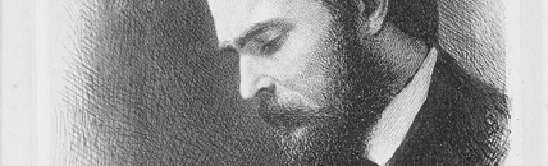
Portrait of Samuel P. Avery
- Description
- Samuel Putnam Avery (1818–1904), a New York-based art dealer and print collector, made annual buying excursions to Europe from 1867 to 1882 to look for decorative arts and paintings, some of which he commissioned directly from the artists. He also searched for prints to add to his own collection, seeking not just the original etchings valued today but also reproductive works by artists like Flameng, Jacquemart, and Rajon. French prints made up the core of his collection, almost 18,000 of which are now in the New York Public Library. Léopold Flameng etched this portrait of Avery in 1876 after a painting by Raimundo de Madrazo y Garreta. The Avery family gave the painting to the Metropolitan Museum in 1904. Madrazo (1841–1920) was a fashionable portrait and genre painter, resident in New York and Paris, who was promoted by Avery.
- Location
- Currently not on view
- Date made
- 1876
- original artist
- Madrazo y Garreta, Raimundo de
- graphic artist
- Flameng, Léopold
- ID Number
- GA*14576
- catalog number
- 14576
- accession number
- 94830
- Data Source
- National Museum of American History, Kenneth E. Behring Center
First Love Letter
- Description
- Camille Piton made this etching to illustrate a catalog for an auction of works from the collection of J. C. Runkle, which was held in New York on March 8, 1883. Samuel P. Avery, art dealer and himself a collector, organized the sale and the catalog. The New York Times judged Piton’s effort as “handsomely etched.” Ludwig Knaus (1829–1910), the original artist of First Love Letter, was a German painter of sentimental genre scenes which were very popular in his day. Originally titled in German, his painting was known by its English title because it had been purchased by an American.
- Location
- Currently not on view
- Date made
- 1879
- original artist
- Knaus, Ludwig
- graphic artist
- Piton, Camille
- ID Number
- GA*14885
- catalog number
- 14885
- accession number
- 94830
- Data Source
- National Museum of American History, Kenneth E. Behring Center
Street Musicians
- Description
- Jean Léon Gérôme (1824–1904) painted this scene of Pifferari or street musicians serenading an unseen image of the Virgin Mary in 1870. Camille Piton etched it for an auction catalog of works from the collection of J. C. Runkle, which were sold on March 8, 1883. The auction was organized by Samuel P. Avery, art dealer and print collector. Pifferari come from the mountains in Calabria, Italy, and from the Abruzzi to play bagpipes and reed instruments like the piffero, a kind of oboe, before images of the Virgin in Rome during the Christmas season. Jean Léon Gérôme was a favorite painter of Stephen Ferris, who named his son after him.
- Location
- Currently not on view
- Date made
- 1879
- 1883
- original artist
- Gerôme, Jean-Léon
- graphic artist
- Piton, Camille
- ID Number
- GA*14886
- catalog number
- 14886
- accession number
- 94830
- Data Source
- National Museum of American History, Kenneth E. Behring Center
Portrait of Frank Duveneck
- Description
- In 1879 William Unger, a Vienna-based artist, etched this reproduction of William Merritt Chase’s 1876 portrait of friend and fellow painter Frank Duveneck, titled The Smoker. Duveneck is wearing a Dutch-style hat and smoking a long Dutch clay pipe as he holds a portrait print after Frans Hals. Unger etched many prints after Hals and other old masters as well as after contemporary artists like Chase. His etchings were published widely in both Europe and the United States. Some appeared loose in portfolios so that they could be framed or set up on an easel for study.
- Frank Duveneck (1848–1919), son of German immigrants, began his art studies in the United States. Dissatisfied with the experience, he went to Munich in 1870 to attend classes at the Bavarian Royal Academy, where he met William Merritt Chase in 1872. He and Chase became close friends and Chase made several portraits of Duveneck during their years in Munich.
- Location
- Currently not on view
- Date made
- 1879
- original artist
- Chase, William Merritt
- graphic artist
- Unger, William
- ID Number
- GA*14974
- catalog number
- 14974
- accession number
- 94830
- Data Source
- National Museum of American History, Kenneth E. Behring Center
Portrait of a Moor
- Description
- The 1876 Centennial Exposition brought people and exhibits from around the world to Philadelphia’s Fairmount Park. Stephen Ferris, a resident of the city, visited the site on August 7 and recorded in pencil the face of this man, whom he called Maure [Moor]. The man may have been one of the workers associated with an exhibit from Tunisia or Morocco. Ferris was very interested in North African subject matter at this time, due to his fondness for the works of Mariano Fortuny.
- Location
- Currently not on view
- date made
- 1876
- original artist
- Ferris, Stephen James
- ID Number
- GA*16664
- catalog number
- GA*16664
- accession number
- 119,780
- Data Source
- National Museum of American History, Kenneth E. Behring Center
Portrait of Jean-Léon Gérôme
- Description
- Stephen Ferris etched a dapper J. L. Gérôme (1824–1904) in 1899, near the end of Gérôme’s very successful career as painter and sculptor. Ferris had admired the French artist’s work for many years, at least since 1863 when he named his son after him. Although Ferris never actually met Gérôme, the two artists had corresponded. For this print Ferris used a photograph he had received from Gérôme. He then sent Gérôme trial proofs for comments and requested a signature to include in the final impressions, which appears here at lower left.
- Gérôme congratulated Ferris on the portrait as “work done with great care and great talent—the effect is very good and very firm. If I had any criticism to make, I would reserve it for the background, which is a little too even, and for the clothing, which has a little softness in the execution.” Gérôme also suggested that the highlight on the order which appears on his left breast and is not particularly noticeable in the photograph, be less bright. The order remains brightly lit, possibly Ferris’s tribute to Gérôme.
- Location
- Currently not on view
- Date made
- 1879
- date made
- 1899
- graphic artist
- Ferris, Stephen James
- ID Number
- GA*14396.01
- accession number
- 94830
- catalog number
- 14396.01
- Data Source
- National Museum of American History, Kenneth E. Behring Center
Portrait of Mariano Fortuny
- Description
- This profile portrait of Spanish painter and graphic artist Mariano Fortuny is one of two in the NMAH collection that Stephen Ferris made in 1875, soon after Fortuny’s untimely death at age thirty-six in Rome, Italy, on November 21, 1874.
- Gerome Ferris, in a note on the mount, refers to the print as an etching on glass. According to a contemporary, Stephen Ferris “was one of the first artists to practice etching on glass as it was miscalled at the time.” The cliché-verre process, as it known today, originated in France in the nineteenth century. The artist coats a glass plate with an opaque substance and then draws an image on it with a pointed instrument such as an etching needle. He then lays the plate image-side down on a sheet of photosensitized paper and exposes it to light.
- This print and a second portrait of Fortuny by Ferris were the only two American etched portraits shown in the 1876 Philadelphia Centennial Exhibition. The revival of interest in etching that began in Europe during the 1860s did not really take off in the United States until about 1880, but visitors to the exhibition saw a modest number of American etchings at the beginning of the movement.
- Location
- Currently not on view
- date made
- 1873
- 1875
- graphic artist
- Ferris, Stephen James
- ID Number
- GA*14552
- catalog number
- 14552
- accession number
- 94830
- Data Source
- National Museum of American History, Kenneth E. Behring Center
North African Pirate
- Description
- Deeply impressed by the art of Mariano Fortuny, Stephen Ferris etched reproductions of Fortuny’s paintings and a few of his prints. Ferris made this etching, Riff Pirate, after a painting dated 1871. These pirates preyed on shipping off the North African coast. The Philadelphia Museum of Art owns a related painting, which may be seen on its website.
- Location
- Currently not on view
- Date made
- 1871
- original artist
- Fortuny y Carbo, Mariano
- graphic artist
- Ferris, Stephen James
- ID Number
- GA*14379.01
- accession number
- 94830
- catalog number
- 14379.01
- Data Source
- National Museum of American History, Kenneth E. Behring Center
Roman Chariot Race
- Description
- Stephen Ferris collaborated with his brother-in-law Peter Moran in 1875 to make this large 22 x 57cm reproductive etching of Alexander von Wagner’s stirring painting Chariot Race in the Circus Maximus, Rome in the Presence of the Emperor Domitian. The scale of the etching required an oversized copper plate, which was difficult to find. Ferris and Moran fabricated one from the bottom of a copper boiler. According to one source, Moran, who would later specialize in farm animals, etched the horses, the archway in the background, and the roadway. Ferris, later known for his portraits, etched the figures and the rest of the architecture. At the time this etching was one of the largest made in the United States. The print was well received; the New York Times noted: “Of the style of execution we can speak only in the highest terms.”
- Alexander von Wagner (1838–1919), a Hungarian artist active in Germany, also enjoyed considerable success when he exhibited the painting Chariot Race in Europe in 1872. Wagner painted other versions; one was shown to critical acclaim at the Centennial Exhibition in Philadelphia in 1876. The Manchester Art Gallery in England owns a version, which may be seen on its website. It was not unusual at that time for an artist to paint several replicas of a popular subject in different sizes.
- Location
- Currently not on view
- Date made
- 1882
- 1875
- graphic artist
- Ferris, Stephen James
- original artist
- Wagner
- graphic artist
- Moran, Peter
- publisher
- J. C. McCurdy & Co.
- ID Number
- GA*14534
- catalog number
- 14534
- accession number
- 94830
- Data Source
- National Museum of American History, Kenneth E. Behring Center
Portrait of Elizabeth Moran Ferris
- Description
- Stephen Ferris drew this pencil portrait of his wife, Elizabeth Anastasia Moran Ferris, in 1878. Ferris probably met Elizabeth through his friendship with her brothers, artists Thomas and Peter Moran. The couple married in 1862. Their son, Jean Leon Gerome Ferris, a history painter and etcher, was born in 1863 and their daughter, May Electa Ferris, a landscape painter and etcher, in 1871.
- Location
- Currently not on view
- date made
- 1878
- original artist
- Ferris, Stephen James
- ID Number
- GA*16649
- catalog number
- GA*16649
- accession number
- 119,780
- Data Source
- National Museum of American History, Kenneth E. Behring Center
- Next Page

