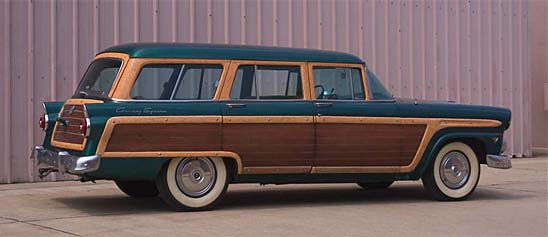
Transportation - Overview

Americans have always been a people on the move—on rails, roads, and waterways (for travel through the air, visit the National Air and Space Museum). In the transportation collections, railroad objects range from tools, tracks, and many train models to the massive 1401, a 280-ton locomotive built in 1926. Road vehicles include coaches, buggies, wagons, trucks, motorcycles, bicycles, and automobiles—from the days before the Model T to modern race cars. The accessories of travel are part of the collections, too, from streetlights, gas pumps, and traffic signals to goggles and overcoats.
In the maritime collections, more than 7,000 design plans and scores of ship models show the evolution of sailing ships and other vessels. Other items range from scrimshaw, photographs, and marine paintings to life jackets from the Titanic.
"Transportation - Overview" showing 3 items.
Ship Model, Tobacco Ship Brilliant
- Description
- This is a 1/8-scale model of the tobacco ship Brilliant, a 250-ton vessel built in Virginia in 1775 for British owners. The Brilliant's first and probably only commercial venture from Virginia took place when it set sail for Liverpool, with a full hold of tobacco, in the summer of 1775. Typically the Brilliant would have returned with manufactured goods, but because of growing hostilities between Britain and the colonies, the ship remained in England. Records show that the Brilliant made one voyage to Jamaica and returned to London in 1776. Later that year, the Royal Navy purchased the vessel for just over £3,000 and converted it to a ship of war for service in the American Revolution.
- The ship Brilliant had three masts and square-rigged sails. Its lower deck was 89'-3" long, its breadth was 27'-1/2", and the depth of the hold was 12'-2". The ship was built of oak, pine, and cedar. When purchased for war service, the Royal Navy assessed its hull, masts, and yards at £2,143. The cordage, including halyards, sheets, tack, and anchor cables, were assessed at £340. Brilliant's sails, 27 in all, were valued at £143. Five anchors were assessed at £58, while a long boat with a sailing rig and oars was estimated to be worth £45. Other items aboard the Brilliant were inventoried, including block and tackle, metal fittings, iron-bound water casks, hour and minute glasses, compasses, hammocks, an iron fire hearth, and 10 tons of coal.
- After its conversion in 1776 as a ship of war in the Royal Navy, the Brilliant was commissioned as the HMS Druid. Its first voyage westbound across the Atlantic was as an escort for a convoy to the West Indies. The vessel served as the Druid until 1779, after which it became the fire ship Blast. In 1783, it was sold out of the service for £940 and, for the next 15 years, the former Virginia tobacco ship served as a whaler in Greenland. The vessel was lost in the Arctic in 1798.
- This model was built by Charles and N. David Newcomb of Bolingbroke Marine in Trappe, Md. The model makers began their work in March 1975, scaling every timber to size and making everything out of the same type of wood as the original. They devised miniature rope-making equipment to manufacture the 5,000 feet of rigging and anchor cable required in 20 different sizes. Women from the Newcomb family and the surrounding community made the rigging and sails.
- The model makers left the starboard side of the vessel unplanked to reveal the timbering and joinery of the hull and to permit a view of the vessel’s living accommodations in the stern and cargo stowage, complete with tobacco hogsheads.
- Date made
- 1978
- ship built
- 1775
- voyage to Jamaica
- 1776
- became a ship of war in Royal Navy
- 1776
- ship lost at sea
- 1798
- maker
- Newcombe, Charles J.
- Newcomb, N. David
- ID Number
- TR*335672
- catalog number
- 335672
- accession number
- 1978.0403
- Data Source
- National Museum of American History, Kenneth E. Behring Center
Ship Model, Chesapeake Bay Log Canoe
- Description
- This model of a Chesapeake Bay log canoe was built in 1880 and displayed at the Great International Fisheries Exhibition in London in 1883. It shows a two-masted log canoe with a mustard-colored hull. Although this model may look more like a recreational sailboat than a traditional paddling canoe, its roots can be traced back to the dugouts built and used by American Indians. Native Americans along the bay used dugouts, made by hollowing out a single tree trunk, to spear fish, gather oysters, and travel from one village to another. Europeans adopted the log-canoe technology shortly after arriving in the region in the early 1600s. By the start of the 18th century, colonists had modified the standard, single-log dugout, by hewing and shaping several logs and fitting them together to enlarge the craft. They added masts and sails, providing the means to travel farther and giving the vessels their distinctive appearance.
- Despite the widespread use of frame-and-plank shipbuilding techniques around the Chesapeake, watermen continued building and using log canoes well into the 20th century. The canoes were ideal for oyster tonging in the many protected creeks and rivers that flow into the bay. This model includes a pair of hand tongs of the sort made by local blacksmiths for oystermen. A waterman would anchor his canoe over an oyster bed and lower the tongs into the water. With a scissoring motion, he would rake the tongs together until the iron basket was full and ready to be lifted onboard.
- In terms of construction, the log canoe is the forerunner to the bugeye, which is essentially an enlarged canoe built of seven or nine logs with a full deck added over the hold. While log canoes are no longer used in commercial fishing, they can still be seen in special sailboat races on the Eastern Shore of the Chesapeake.
- date made
- 1880
- ID Number
- TR*025003
- catalog number
- 025003
- accession number
- 4586
- Data Source
- National Museum of American History, Kenneth E. Behring Center
Whaler's Shoulder or Darting Gun
- Description
- By the later 19th century, guns had replaced most hand harpoons and lances, since they were far more efficient and deadly to the prey. They also could be shot from a safer distance from the prey than the hand tools could be wielded. The darting gun was one of the more popular types. Loaded with different darts, this versatile weapon could be used both for harpooning and killing whales.
- This particular gun was displayed at the 1883 International Fisheries Exhibition in London, England. After the display ended, it was donated to the Smithsonian by its inventor, Capt. Eben Pierce of New Bedford, Mass.
- date made
- 1880s
- guns replaced hand tools
- late 19th century
- displayed at the International Fisheries Exhibition
- 1883
- maker
- Pierce, Eben
- ID Number
- TR*316550
- catalog number
- 316550
- accession number
- 66767
- Data Source
- National Museum of American History, Kenneth E. Behring Center